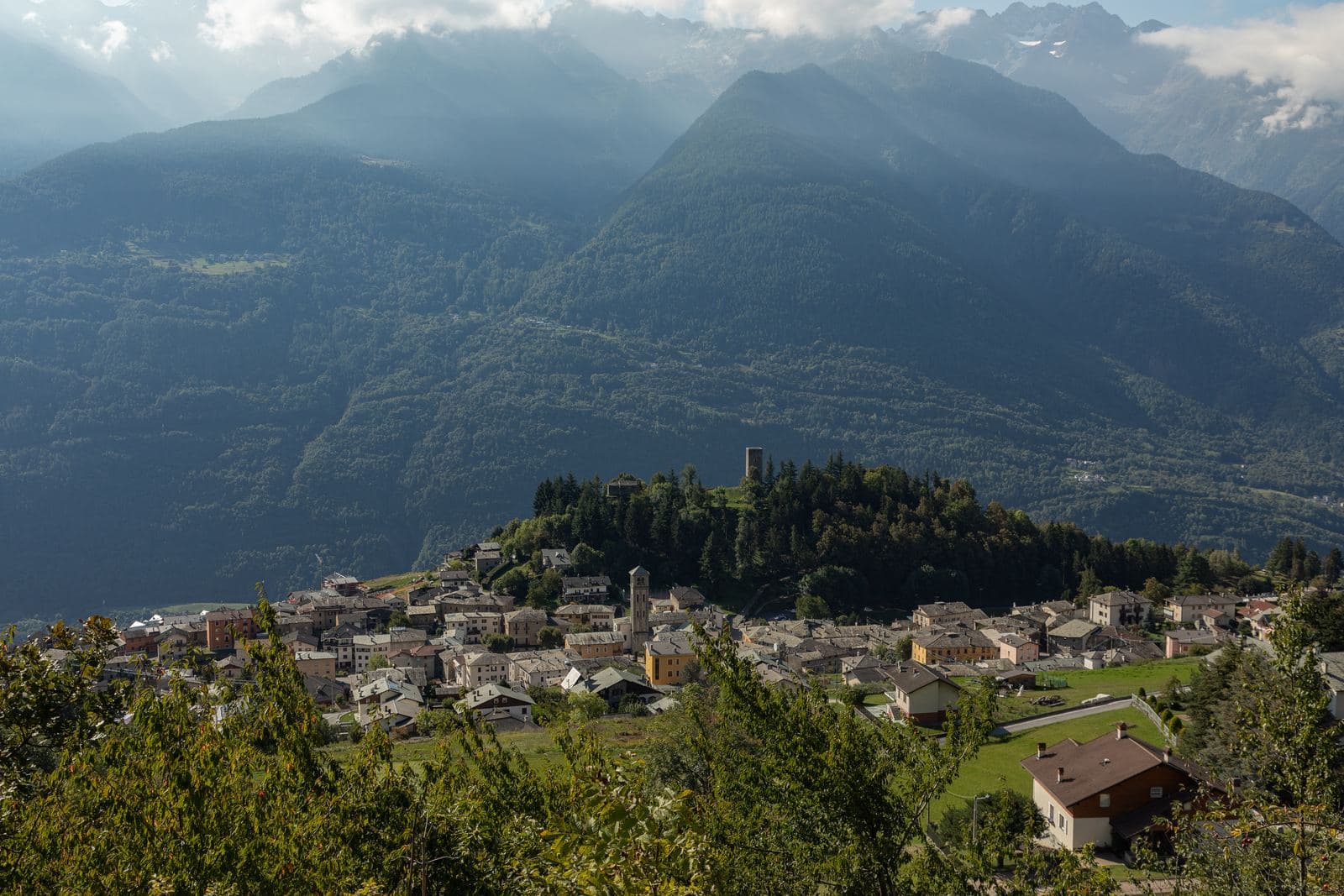
Photo: Maurizio Moro5153 · CC BY-SA 4.0

Very easy to reach
A sunlit terrace above the valley, a medieval tower, a Renaissance palace and the dish that travelled the world: pizzoccheri, guarded by an Academy.
- Type
- Panoramic point
- Municipality
- Teglio
- From Tirano
- Visit time
- Opening
- Always accessibleAn outdoor place, always reachable (at low altitude; ice or snow possible in winter).Indicative dates, not official: check before you go.
- Interests
- Nature and Landscape
- Activities
- Hiking
You arrive climbing from Tresenda, among vines and gentle bends, and at some point the mountain levels out. Teglio sits there, on a sun-drenched terrace, looking down on Valtellina with the confidence of a place that has been here for millennia. From the edge of the village your gaze slides over the valley floor to the Orobie on the far side: no wonder everyone calls it the Balcony of Valtellina.
To grasp how vast the view is, climb the Torre de li Beli Miri. What remains of it belonged to the ancient Castrum Tilii, a medieval castle built on Roman foundations, and today you reach the top by an internal staircase: from the terrace your gaze runs some sixty kilometres. Beside it stands the little church of Santo Stefano, of early medieval origin, once the garrison's oratory. You reach it on foot from the Pineta, which is already a lovely walk.
Teglio's history is as long as its view. Its origins go back to the 3rd millennium BC, and the engraved stelae kept in the Antiquarium Tellinum tell it without need of words. In Roman times it was a strategic point of Alpine communications; in 1335 it became part of the Duchy of Milan; in 1432 it was destroyed for its loyalty to Venice. Its name, perhaps linked to the linden tree, according to tradition gave its name to the whole valley: Valtellina is, at heart, the “valley of Teglio”.
Then there is Palazzo Besta, and here you must slow down. Built in the late 15th century by the Besta family, who held it until 1726, it was conceived as a true Renaissance court, hosting artists, writers and philosophers. In the courtyard a columned loggia is frescoed with scenes from the Aeneid; in the great hall unfold episodes from Orlando Furioso; and there are the Creation Room, a small studiolo with an umbrella-shaped ceiling and the typical wood-panelled stüe. On the ground floor the Antiquarium Tellinum keeps the Copper Age stelae, including Caven 3, the so-called Mother Goddess. It has been a state museum since 1927 and unquestionably deserves a morning.
In the square the church of Sant'Eufemia awaits you, the religious heart of the village. Excavations in 2011-2012 brought to light a first church from the 5th-6th centuries; around the 11th century a larger Romanesque one was built, consecrated in 1117 by the Bishop of Como Guido Grimoldi. The present appearance is largely 16th-century, with the Renaissance portal carved in 1506 by the Rodari and a marble rose window with the Madonna. Inside and out it is a book of stone, open across eight centuries.
And then we arrive at the table, because in Teglio one always does. Buckwheat has been grown here for over four centuries, and its signature dish, pizzoccheri, was born in these houses: dark buckwheat pasta, cabbage or chard, potatoes, Casera cheese, butter, garlic and sage. Old documents say little, and testimonies go back not much more than a century, but here nobody doubts it: pizzoccheri belong to Teglio. To see where it all begins, visit the Mulino Menaglio, an ancient water mill still at work, where buckwheat itself is ground, open during events and guided visits.
This tradition has a guardian: the Accademia del Pizzocchero di Teglio. It was founded on 2 August 2002 by Rezio Donchi and twenty-six founding members, who signed the deed before the notary Schiantarelli in Tirano. The idea was simple and a little bold: to defend the signature dish of Valtellina cuisine from imitations and make it a symbol of an ancient culture, while supporting the work of restaurateurs and hoteliers. The Academy protects the original recipe, which for its members “is only one”: little greenery, al dente potatoes, a flavourful pasta and cheese that stretches. In member restaurants the dish often arrives with an explanation and a demonstration, because understanding how it is born makes the first bite taste much better.
The best time to meet it is autumn. From September to November, with “Pizzocchero d'Oro e Sapori d'Autunno”, Teglio becomes one great table for thirteen weekends: it starts with pizzoccheri in September, then mushrooms, game and the flavours of November, always accompanied by Valtellina wines. In July, instead, there is the Sagra dei Pizzoccheri, a three-day festival that in 2026 reached its 65th edition. No surprise that Teglio is a Cittaslow town, the historic and gastronomic capital of Valtellina.
After so much table, walking is a pleasant duty. Through Teglio runs the Via dei Terrazzamenti, a 70-kilometre route from Morbegno to Tirano that crosses vineyards, orchards, villages, churches and castles on the Rhaetian side, on foot or by bike. The Cammino Mariano delle Alpi also passes here. And when you are in Tirano, Teglio is right there, a few minutes away: a balcony worth the climb.
From Tirano: distance, driving time and day trip
Balcony of Valtellina from Tirano: about 20 minutes by car (17 km). You follow the SS38 towards Sondrio and at Tresenda climb to Teglio, the village of pizzoccheri. It is so close that it can be combined with a stroll in Tirano: the morning here, the afternoon among the city's squares and cafés. Where to stay to visit the Valtellina? In Tirano: close to the Swiss border, the Bernina Express station and the roads to Bormio, Livigno and Aprica.
Local excellence
Restaurant
Ristorante Ai Tigli
Restaurant
Ristorante La Galeda
Restaurant
Ristorante Combolo
Restaurant
Ristorante Al Castello
Photo: Dario Crespi · CC BY-SA 4.0, Maurizio Moro5153 · CC BY-SA 4.0, Geobia · CC BY-SA 4.0, Geobia · CC BY-SA 4.0