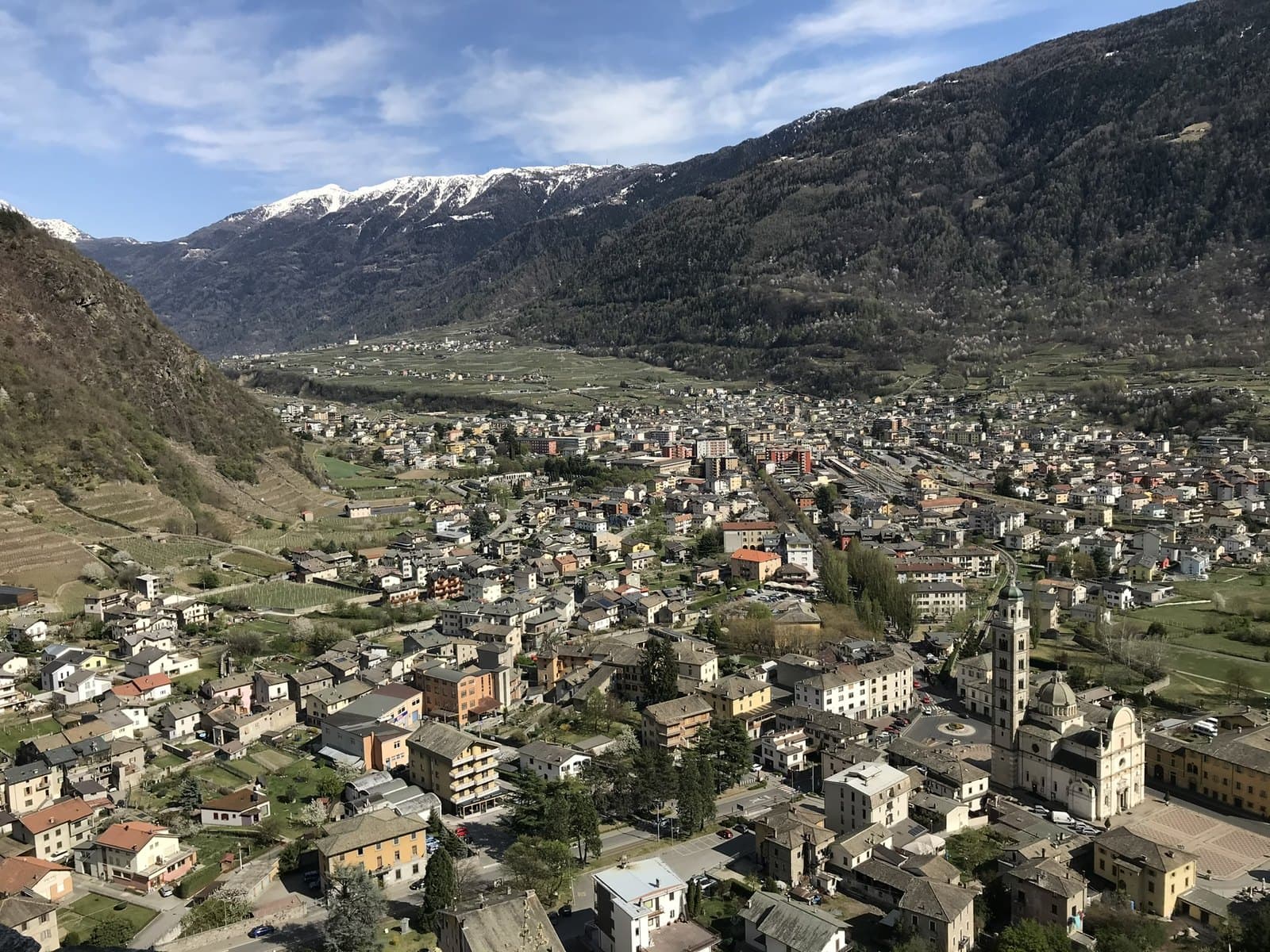
Photo: © Claudio Corcoglioniti
A stone's throw from Tirano
The Renaissance sanctuary born from an apparition in 1504: stucco, wood carving and an extraordinarily rich 17th-century organ, to be admired at leisure.
- Type
- Sanctuary
- Municipality
- Tirano
- From Tirano
- Visit time
- Opening
- July 1 - September 30 · 07:00-19:00October 1 - June 30 · 07:00-11:45, 14:30-18:45During services tourist visits may be limited.Checked on October 29, 2026.
- Interests
- History and Culture
The story
On 29 September 1504 the Virgin is said to have appeared to Mario Omodei, a man from Tirano, asking for a temple to be built on the spot and promising an end to the plague that was afflicting the valley. The foundation stone was laid on 25 March 1505, the feast of the Annunciation, not far from the medieval church of Santa Perpetua.
The exterior was finished in 1513. The church was consecrated on 14 May 1528 by the Bishop of Como, Cesare Trivulzio. The drum and dome were built between 1580 and 1587 under the Campione master builder Pompeo Bianchi. The bell tower, directed by Pietro Marni of Bormio, took more than sixty years, from 1578 to 1641.
In 1927 the sanctuary was given the title of minor basilica. In 1946 Pope Pius XII proclaimed Our Lady of Tirano heavenly patroness of the whole of Valtellina. Since 6 July 2003 it has been a diocesan sanctuary. It is still a destination for pilgrims and for travellers who stop, even just for a moment, to breathe in its silence.
The architecture
As soon as you step into the square, the basilica greets you with its luminous façade: it is regarded as the most important example of Renaissance architecture in Valtellina, with a Latin-cross plan with three naves, pyramidal volumes and oculi marking the rhythm of the façade. The design is, in all likelihood, attributed to Tommaso Rodari, architect of Como Cathedral. His brother Giacomo carved the ornaments of the windows and side doors (around 1534). The main portal (1530-1534) is the work of Alessandro Della Scala of Carona.
Stucco, altars and sculpture
Step inside and let yourself be surprised: the interior is exuberantly rich. Stucco, gilding, sculpture and frescoes cover walls and vaults, with candelabra and reliefs by the Rodari on the pilasters. On the wall of the left nave, a frescoed scene of the apparition, dated 1513, tells the event from which everything began.
The devotional heart is the four-sided altar that Giovan Angelo and Tiburzio Del Maino made between 1519 and 1524. The faithful could see the statue of the Madonna and pray from the back as well. The marble altar that now holds it dates from the 19th century and replaced the wooden one, requisitioned in 1798 by the authorities of the Cisalpine Republic. The high altar is a Baroque work with marble inlay, dated 1748.
Pause in front of the wooden pulpit: it bears the dates 1599 and 1600 carved into it, and it is a masterpiece of wood sculpture by an unknown hand. Beside it stands the 18th-century choir loft by Giovan Antonio Pianta, with panels painted by Giovan Pietro Romegialli of Morbegno.
The organ
This is the piece that takes your breath away. The sanctuary already had an organ around 1550. In 1608 the building committee commissioned the Brescian sculptor Giuseppe Bulgarini to make a new monumental organ gallery, supported by eight red marble columns. In 1617 the work was delivered still unfinished. The case is a forest of carving: vine shoots and bunches of grapes, more than a hundred and fifty sculpted musical instruments, and at the top God the Father with three dancing cherubs. In 1624 Bishop Sisto Carcano, judging it out of proportion, even ordered its demolition: the order was never carried out, and thank goodness.
The parapet of the choir loft is the other jewel: atlantes, grotesque masks and musical symbols frame carved panels. Three are by the Milanese Giovanni Battista Salmoiraghi, who worked on them from 1638: the Circumcision, the Adoration of the Shepherds and the Adoration of the Magi. Two are by Bulgarini: the Archangel Michael and the Apparition of the Madonna to Mario Omodei. The gilding was done in 1653 by Giovanni Casolar of Bormio. During Holy Week the front of the organ was covered by a large canvas of the Coronation of the Virgin, painted around 1650 by Carlo Marni and Domenico Stella.
The musical instrument itself has a layered history: a first organ by Cristoforo Valvassori, tested in 1609; a new one by Michelangelo Valvassori in 1641; then the one built by Giovanni Bossi in 1813 inside the original case, enlarged by Luigi Parietti in 1882 and restored in 1970 by the Piccinelli firm. Today it has two keyboards of 66 keys and a 24-note pedalboard, with a front of five bays of pipes arranged in a pointed shape.
Visiting the basilica
Entrance is free and a visit takes about an hour: take your time and look up. From 1 October 2026 the basilica is open every day from 7.00 to 11.45 and from 14.30 to 18.45, with continuous opening (7.00-19.00) in July, August and September. Weekday Masses are at 9.00 and 17.30, Sunday and holiday Masses at 7.30, 9.30, 11.00 and 17.30. During services sightseeing may be limited: up-to-date times are on the official website (santuariomadonnaditirano.it). It stands in Piazza Basilica, a few minutes' walk from the station where the Bernina Red Train arrives: an excellent first stop, or a gentle farewell, for your day in Tirano.
From Tirano: distance, driving time and day trip
The Basilica is about a kilometre and a half from the centre: a twenty-minute walk along Viale Italia, among shops and cafés, or a few minutes by car or city bus. The Red Train runs right beside the sanctuary: there is no better way to begin, and to end, a day in Tirano.
Local excellence
Restaurant
Parravicini Restaurant & Wine
Restaurant
Osteria Roncaiola
Restaurant
Contrada Beltramelli
Restaurant
Vineria Tirano
Restaurant
Bistrot Merizzi
Restaurant
Pizzeria Il Braciere
Restaurant
Pizzeria Ristorante La Botte
Gallery
Photo: © Claudio Corcoglioniti, Zairon · CC BY-SA 4.0, Zairon · CC BY-SA 4.0, Zairon · CC BY-SA 4.0, Zairon · CC BY-SA 4.0, Zairon · CC BY-SA 4.0, Maurizio Moro5153 · CC BY-SA 4.0, Zairon · CC BY-SA 4.0, Zairon · CC BY-SA 4.0, Zairon · CC BY-SA 4.0, Zairon · CC BY-SA 4.0, Zairon · CC BY-SA 4.0, Zairon · CC BY-SA 4.0, Zairon · CC BY-SA 4.0, Mattia Gusmerini · CC0, Zairon · CC BY-SA 4.0, Zairon · CC BY-SA 4.0, Zairon · CC BY-SA 4.0