Photo: Orobicon · Public domain

Very easy to reach · by car to the nearest point, then on foot
A multiple-arch dam inaugurated in 1926, unique in the world for its time: eight concrete vaults resting on buttresses, in a basin where a glacial lake once lay.
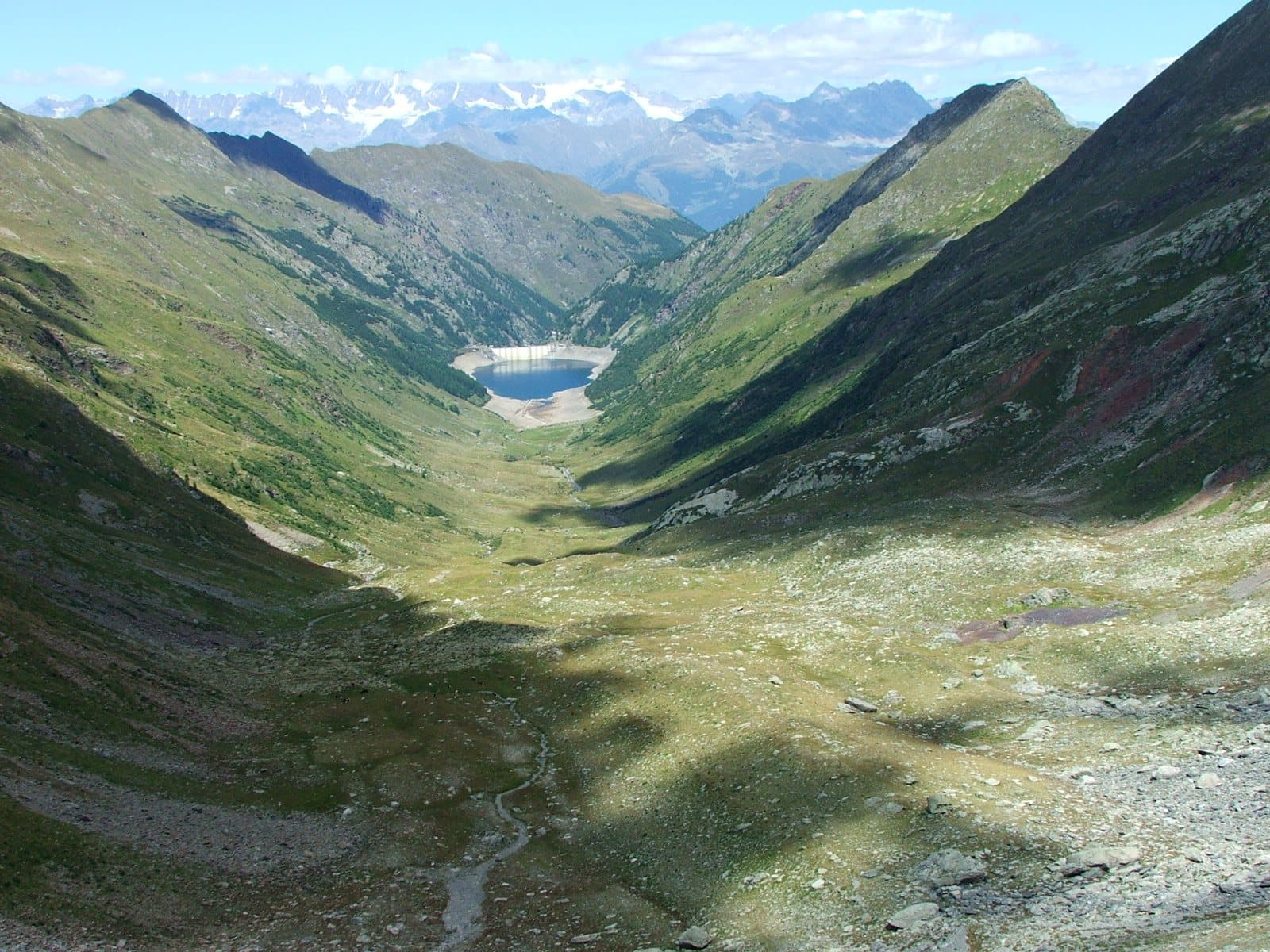
A high-altitude lake under Pizzo Redorta
High above Piateda, in the Val Venina, in the Orobie Valtellinesi Park, lies an artificial lake at about 1,823 metres: 0.4 square kilometres, up to 48 metres deep and holding about 11 million cubic metres of water. All around, the highest mountains of the Orobie: Pizzo Redorta and Punta Scais, both over three thousand metres. At about 2,200 metres the valley keeps the remains of ancient mines and smelters, another memory of work at altitude.
The dam: history, capacity and the hydroelectric system
There is something almost theatrical about this dam. It stands where an ancient glacial lake once lay, and when you arrive at altitude you realise it looks like no other in the Orobie: not a compact wall, but a procession of eight cylindrical concrete vaults, full-centre, with vertical generatrices, resting on nine buttresses, like the arches of a concrete cloister. It is a multiple-arch dam, and according to Edison it was a structure unique in the world for its time.
It was designed by the engineers Pietro Bonetti, Carlo Mina and Luigi Scalabrini for the Falck group, which in the 1920s was building its system of power stations in the Valtellina: work began in the summer of 1922 and lasted about three years, and the work was inaugurated in 1926 (Edison, which celebrated its centenary in June 2026, gives 1926; other sources give the completion of the power station in 1923). Height and exact data vary from source to source, about 50-60 metres is quoted, and the reservoir of about 11 million cubic metres is a regulating reservoir, not one of the giants of the Adda: its task was to collect the waters of glaciers and streams and channel them to the power stations below.
Today the dam belongs to Edison, which since 2000 has absorbed the plants of the Falck group and in the Valtellina runs an integrated hub of seven power stations (Venina, Ganda, Belviso, Armisa, Publino, Zappello and Vedello) and seven dams and reservoirs. Venina is the oldest milestone of that system: a feat of engineering built with the labour of the valley's inhabitants, which for over a century has turned the water of the Alps into energy for the country. Walking up here means meeting a piece of Alpine industrial history set in a landscape that has lost none of its beauty.
From Tirano: distance, driving time and day trip
Lake and dam of Venina from Tirano: about 25 minutes by car (21 km), along the SS38 towards Sondrio to Piateda, the starting point of the walk; the dam is then reached on foot. To these times add the walk described on this page: plan your day accordingly. From Tirano, the Alpine Hub of the Valtellina, you can easily organise day trips: in the evening you return to restaurants, shops and a good dinner.
How to get there
From Tirano follow the SS38 towards Sondrio to Piateda, on the valley floor, on the Orobie side; from here continue on foot along the Val Venina. Always check the road and the condition of the path before setting out: the Orobie valleys stay snowy until late spring.
What to do
You climb on foot from Piateda: according to a local guide the route is of medium difficulty, about 700 metres of ascent and takes 3-4 hours there and back. On the route and at the dam you find the remains of another era; those who want to aim higher can continue towards the peaks of the Orobie, which however require mountaineering experience.
Before you go
The best period runs from late spring to autumn. Bring boots, water and a jacket: at 1,800 metres the weather changes quickly. The route is in a nature park: stay on the paths and take your rubbish away.