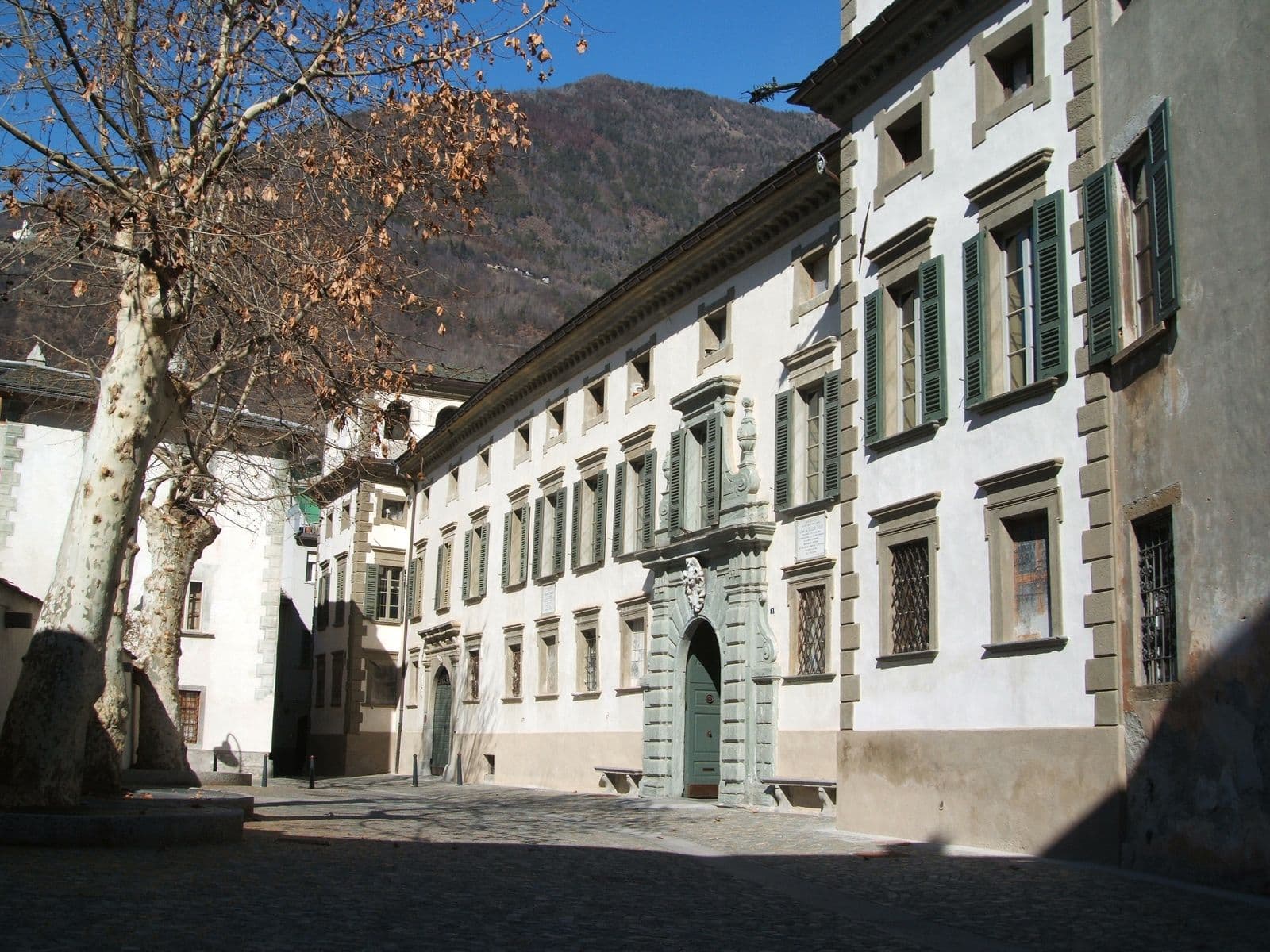
Photo: Salis Tirano · CC BY-SA 3.0

A stone's throw from Tirano
Tickets and bookings
Tickets are bought on the operator's official website.
A 17th-century noble residence in the heart of Tirano: Baroque portal, ten frescoed rooms, a chapel and one of the very few Italian gardens in the Alps, waiting to be discovered.
- Type
- Historic palace
- Municipality
- Tirano
- From Tirano
- Visit time
- Opening
- May 1 - September 30 · Mon-Sat · 10:00-17:00Booking for groupsThe museum is open from May to September, Monday to Saturday, 10 am to 5 pm (last entry at 5 pm); the rest of the year by reservation only, also for groups.Checked on November 12, 2026.
- Interests
- History and Culture
A family home that tells eight centuries
In the heart of Tirano, at Via Salis 3, a late 16th-century façade flanked by two towers guards one of the most precious historic residences in the province of Sondrio. Stepping inside brings a rare feeling: that of entering a house that is still alive. Palazzo Salis has remained for centuries in the hands of the same family, the Counts Sertoli Salis, and still keeps the rooms, furnishings and garden of a great Valtellina noble house. Even the central portal, Baroque in form and inspired by a drawing by Vignola, welcomes you with great elegance.
The Salis, from Lake Como to Valtellina
The story of the Salis spans eight centuries. The family, of Como origin, moved to the Val Bregaglia in the early 12th century and became one of the great houses of the Grisons, which ruled Valtellina from 1512. The Salis-Zizers branch settled in Tirano around the middle of the 17th century and built the palace: sources place the works between about 1630 and 1690, incorporating existing structures from the 15th-16th centuries. Over time the Salis gave Valtellina twenty-five governors, forty-four podestàs and sixteen vicars. On 26 August 1694 Emperor Leopold I granted the title of count to Giovanni Salis. In the 19th century Count Ulisse Salis, a hero of the Risorgimento, had a single daughter, Rita, who married Francesco Sertoli of Sondrio: the Sertoli Salis descend from her.
From the courtyard to the grand staircase
The palace is arranged around an old 16th-century courtyard known as the "rustic court" or "horse court", and a second courtyard with a sundial. From here an imposing grand staircase leads up to the Salone d'onore, where looking up is a pleasure: the ceiling is decorated with 18th-century frescoes attributed to the painter Giovanni Antonio Cucchi and restored in the 1980s. From the entrance, a portico leads you towards the inner garden.
Ten frescoed rooms, one surprise after another
The museum route passes through ten decorated and restored rooms overlooking the courtyard, and each has a story to tell. The Saloncello is the most famous: a vaulted room with trompe-l'œil frescoes, painted balustrades, arches creating perspective effects and, at the centre, Bacchus on a cloud; it was the meeting place of political power in Valtellina in the 17th and 18th centuries, and on the fireplace the coats of arms of the Salis and Wolkenstein families stand out. The Chamber of the 8 Wonders, with eight scenes in perspective-painted lunettes, adds an eighth monument, the Colosseum, to the seven wonders of the ancient world. In the Studiolo of Olympus the gods Jupiter, Apollo, Mercury, Mars and Juno cross the sky on horse-drawn chariots. In the Room of Apollo and Aurora the god's chariot speeds through a blue sky; in the Room of the Turks four framed busts give the vault its name; in the Room of the Telamons twelve figures hold up the ceiling; in the Room of Endymion and the room with the polychrome ceiling the myth of Selene and Endymion is coloured in pink and ochre. And there is the room with the wooden ceiling, where a painted Diana is surrounded by hunting dogs, and the Fireplace Room, with the comital coat of arms granted in 1694.
The little church of San Carlo
Hidden in the palace is the private chapel of San Carlo Borromeo, Baroque in character, which already existed in the early 17th century and used to belong to Captain Simone Venosta. It is entered from Via San Carlo, while the lords reached it from a gallery on the first floor, linked to the palace by a bridge over the street: a small detail that says a lot about how people lived here.
The Italian garden
The most surprising moment of the visit comes when the Italian garden opens up from the portico, one of the most significant in Lombardy. In the Alps it is a real rarity: in the whole of Valtellina there are just two, and this is the larger. Box hedges draw four labyrinthine quadrants around roses and fruit trees, and for over two centuries a majestic Lebanon cedar has watched over the garden; an original plan from 1813 is displayed in the first room of the museum. The visit to the garden is made, on request, together with the museum route: do ask for it, it is worth it.
Wine and the Via Valtellina
Tirano was a commercial and political crossroads between the 16th and 18th centuries, and the Salis made their fortune here with wine. The palace's old cellars bear witness to it, and the image of Bacchus in the Saloncello recalls the trade that carried wine as far as Vienna. The Via Valtellina, the old muleteers' road across the Bernina Pass, carried wine, cured meat, chestnuts and salt to the Engadine, while spices and fabrics arrived from Venice along the Via Priula.
How to visit the palace
The museum is open from May to the end of September, Monday to Saturday (sources give last entry at 4 or 5 pm); for the rest of the year it is open only by booking for groups. Groups can book on other days and at other times and complete the visit with an aperitif, a buffet or a lunch in the rooms. The palace also hosts weddings and conferences, and one part is a residence, the Count's home. It stands in the centre of Tirano, within walking distance of the Bernina Red Train station, and combines well with a day on the Bernina. Opening times may change: use the button at the top for the official pages.
At the table, after the visit
In Tirano the table is part of the journey. Pizzoccheri, sciatt, game and Valtellina wines await you in places in the old town, near the station, or on the slopes of Roncaiola and Villa di Tirano: below is a selection, with the Tripadvisor rating.
From Tirano: distance, driving time and day trip
Palazzo Salis is a few minutes' walk from the station and the squares of the old town: a cultural stop that begins and ends in Tirano, with no need for the car. It combines easily with a stroll among the gates of the Ludovician walls, Piazza Cavour and the cafés of the centre, and with dinner in one of the city's osterie.
Local excellence
Restaurant
Parravicini Restaurant & Wine
Restaurant
Osteria Roncaiola
Restaurant
Contrada Beltramelli
Restaurant
Vineria Tirano
Restaurant
Bistrot Merizzi
Restaurant
Pizzeria Il Braciere
Restaurant
Pizzeria Ristorante La Botte
Gallery
Photo: Abxbay · CC BY-SA 4.0, Asurnipal · CC BY-SA 4.0, Salis Tirano · CC BY-SA 3.0, Asurnipal · CC BY-SA 4.0, Rikki Mitterer · CC BY-SA 4.0, Asurnipal · CC BY-SA 4.0