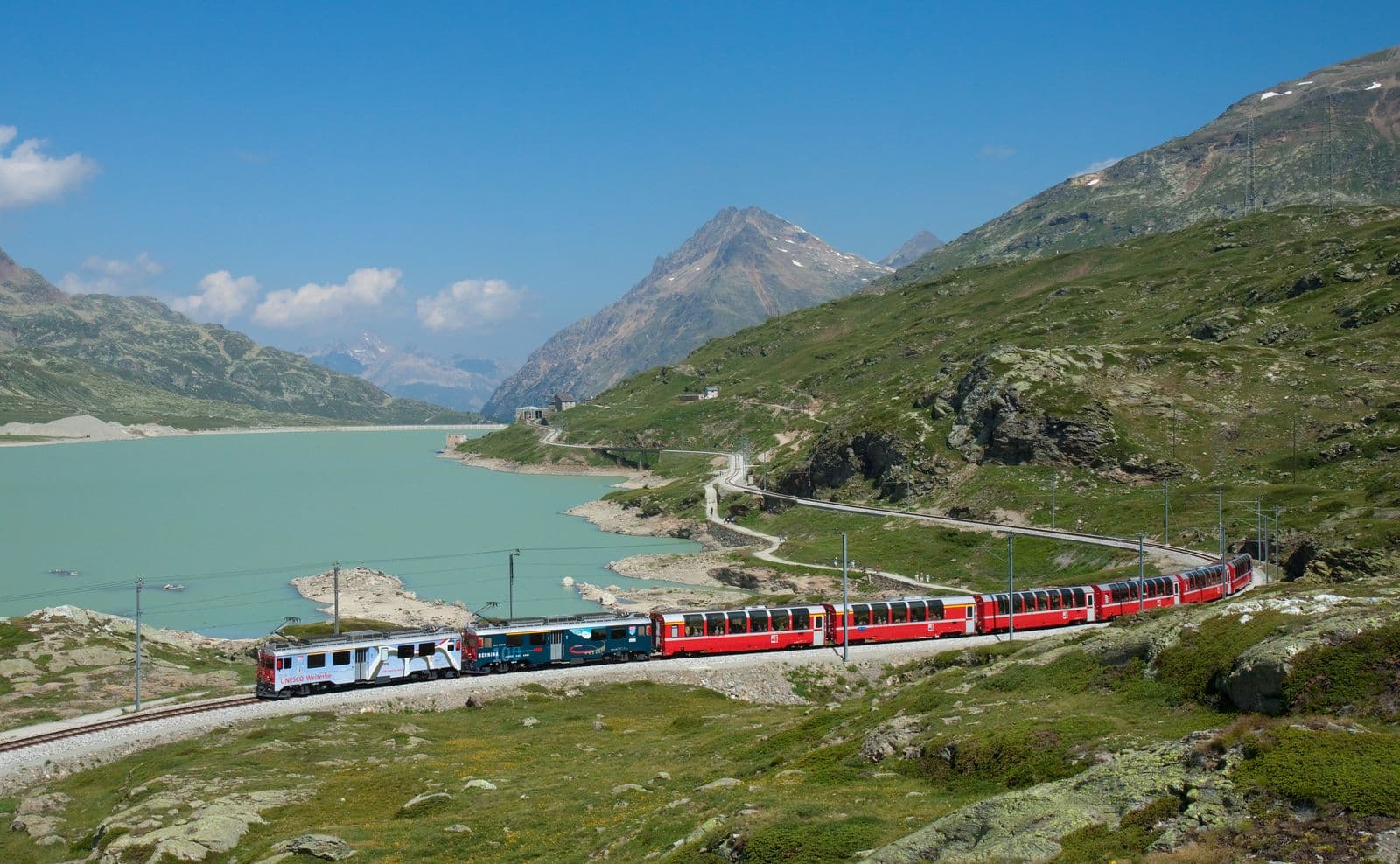
Photo: Kabelleger / David Gubler · CC BY-SA 3.0

A stone's throw from Tirano
Tickets and bookings
Tickets are bought on the operator's official website.
From 429 to 2,253 metres in two and a half hours: the highest metre-gauge railway in the Alps links the palms of Tirano to the glaciers of the Engadine, a UNESCO World Heritage Site since 2008. A journey to enjoy with your nose pressed to the window.
- Type
- Scenic railway
- Municipality
- Tirano
- From Tirano
- Visit time
- Opening
- All yearThe train runs all year: the timetable is on the Rhaetian Railway website.Checked on October 29, 2026.
- Activities
- Mountain bikingTrekking
A red train between two worlds
You set off from Tirano, at 429 metres, among vineyards and bell towers, and in about two and a half hours you reach St. Moritz, at 1,775, after touching the 2,253 metres of the Bernina Hospice. In between there are 61 kilometres of curves, viaducts, turquoise lakes, glaciers mirrored in the windows and a border you cross almost without noticing. The Bernina Red Train is just this: not a way of getting from A to B, but a way of crossing the Alps while looking at them up close, unhurried, with a cup of coffee in your hand and the landscape changing at every bend.
A railway born from a power station
The story begins in 1905, when the Berninabahn company was founded with an ambitious idea: to link Valtellina and the Engadine over the Bernina Pass, at altitudes that no simple-adhesion railway had ever reached. The project was financed by the shareholders of Kraftwerke Brusio, the hydroelectric company of the Valposchiavo, without cantonal subsidies, and was designed from the start for electric traction, a rare choice at the time: the line always ran on direct current, at 750 volts until 1935, then at 1,000.
1908-1910: construction and openings
Works lasted from 1906 to 1910 and the railway opened in stages. On 1 July 1908 Tirano-Poschiavo and Pontresina-Morteratsch were inaugurated; on 18 August 1908 Pontresina-Celerina; on 1 July 1909 Celerina-St. Moritz and Morteratsch-Bernina Suot; and on 5 July 1910 the line was complete, with its highest section, between Bernina Suot and Poschiavo. At first the service was seasonal; from the winter of 1913-1914 the train began running all year round. In 1943-44 the company, in difficulty, was taken over by the Rhaetian Railway (RhB), which still runs it today.
A challenge to adhesion
It is a mountain railway that defies the rules: no rack, only the grip of the wheels on the rails, with gradients of up to 7%, a minimum curve radius of about 43-45 metres and overhead wires up to more than two thousand metres. That is why it is said to be the highest adhesion railway in the Alps and one of the steepest in the world. In winter, snow galleries and rotary snowploughs, including a historic steam one from 1913, keep the line open in the snow: you will feel the train making its way through the white.
The UNESCO heritage
On 7 July 2008 the Bernina line and the Albula line entered the UNESCO World Heritage list under the name "Rhaetian Railway in the Albula / Bernina Landscapes", a cross-border site between Switzerland and Italy. The recognition rewards the meeting of engineering and landscape: viaducts, tunnels and curves designed to sit within the mountain, not against it.
The journey, stop by stop
Tirano (429 m). The journey begins in Tirano. Before boarding it is worth visiting the Basilica of the Madonna di Tirano, about a kilometre from the station.
Campocologno (553 m). It is the first Swiss station and the customs post: bring a valid document, because the train crosses the border.
Brusio. Here stands the symbol of the line, the Brusio spiral viaduct: nine arches in a full curve that serve only to gain height, a circle in the green of the meadows. It is among the most photographed spots of the whole railway.
Miralago and Le Prese. The stops on the shores of Lake Poschiavo offer a walk of about an hour between shore and meadows.
Poschiavo (1,014 m). The main town of the Valposchiavo has a well-preserved old town, with museums and architecture; it is the ideal place for a break.
Cavaglia (1,692 m). Here is the Glacier Garden, a site with ancient glacial formations carved into the rock.
Alp Grüm (2,091 m). For many the most beautiful stop: a balcony at the edge of the forest, with the Palü glacier descending in front. There is a buffet-hotel, and it is one of the places where it is really worth getting off for a stop.
Ospizio Bernina (2,253 m). The highest point of the railway, a step from the lakes: Lago Bianco, artificial and held back by a dam, and Lago Nero, with the Cambrena glacier in the background.
Morteratsch (1,896 m). From here a path of about fifty minutes leads to the Morteratsch glacier. Just before, the Montebello curve is one of the photographers' favourite spots.
Pontresina (1,774 m). An elegant alpine resort, gateway to the Val Roseg.
St. Moritz (1,775 m). The terminus: a luxury town, known for its thermal waters, among lakes and mountains.
The viewpoints not to miss
The stretch many consider the most spectacular is between Cavaglia and the Bernina Hospice: the climb up to Alp Grüm, with the Palü appearing at the station, and then the shore of Lago Bianco, where the railway runs beside the water. At such altitudes the landscape changes quickly: from forest to pasture, to rock, to glaciers. Keep your camera within reach.
Which train to choose
Two kinds of train run on the line, and they follow the same route. The Bernina Express has panoramic carriages, with windows that rise to the roof for a 360-degree view, free Wi-Fi and a snack and drinks service; seat reservation is compulsory in addition to the ticket, and there is also the Pullman Class, with a maximum of 32 passengers per run. The regional train has ordinary carriages, with opening windows, excellent for photographs; reservation is recommended (5 francs) but not compulsory, and trains run every hour, all year round. The Bernina Express also links Chur to Tirano in about four hours, and from Tirano a bus goes to Lugano. Bicycle carriage is also typically available on the trains, but it must be checked for each train and run, because not all of them offer it: check the official website before leaving. It is an excellent base for walks and mountain-bike excursions, with paths starting from the stops, such as those around Lake Poschiavo and Morteratsch.
When to go
Every season has its own journey. Winter is a white fairy tale; spring brings flowers; summer the open carriages, with an unobstructed 360-degree view; autumn the golden larches. It is best to avoid weekends and public holidays and to prefer Monday to Thursday, and to book early. Bring an extra layer: at more than two thousand metres it is cool even in summer.
Tickets and reservations
Tickets and reservations are bought on the official website of the Rhaetian Railway (RhB): use the button at the top of the page to go straight to the official pages. Always check up-to-date timetables and prices before leaving, and then all that is left is to climb aboard.
From Tirano: distance, driving time and day trip
The Red Train leaves from the station square in the heart of Tirano: you can sleep in a hotel in the centre, have breakfast and board the train without ever taking the car. On your return the city is there to welcome you, with its restaurants, pastry shops and evening strolls. This is also why Tirano is the natural starting point for the Bernina and for the whole Valtellina.
Photo: Asurnipal · CC BY-SA 4.0, Kabelleger / David Gubler · Public domain, Asurnipal · CC BY-SA 4.0, Leonhard Lenz · CC0, Lord Koxinga · CC BY-SA 3.0, Leonhard Lenz · CC0, Leonhard Lenz · CC0, Patryk Hejduk · CC BY-SA 4.0, Stefans Pixmix · CC BY-SA 4.0, Cayambe · CC BY-SA 4.0