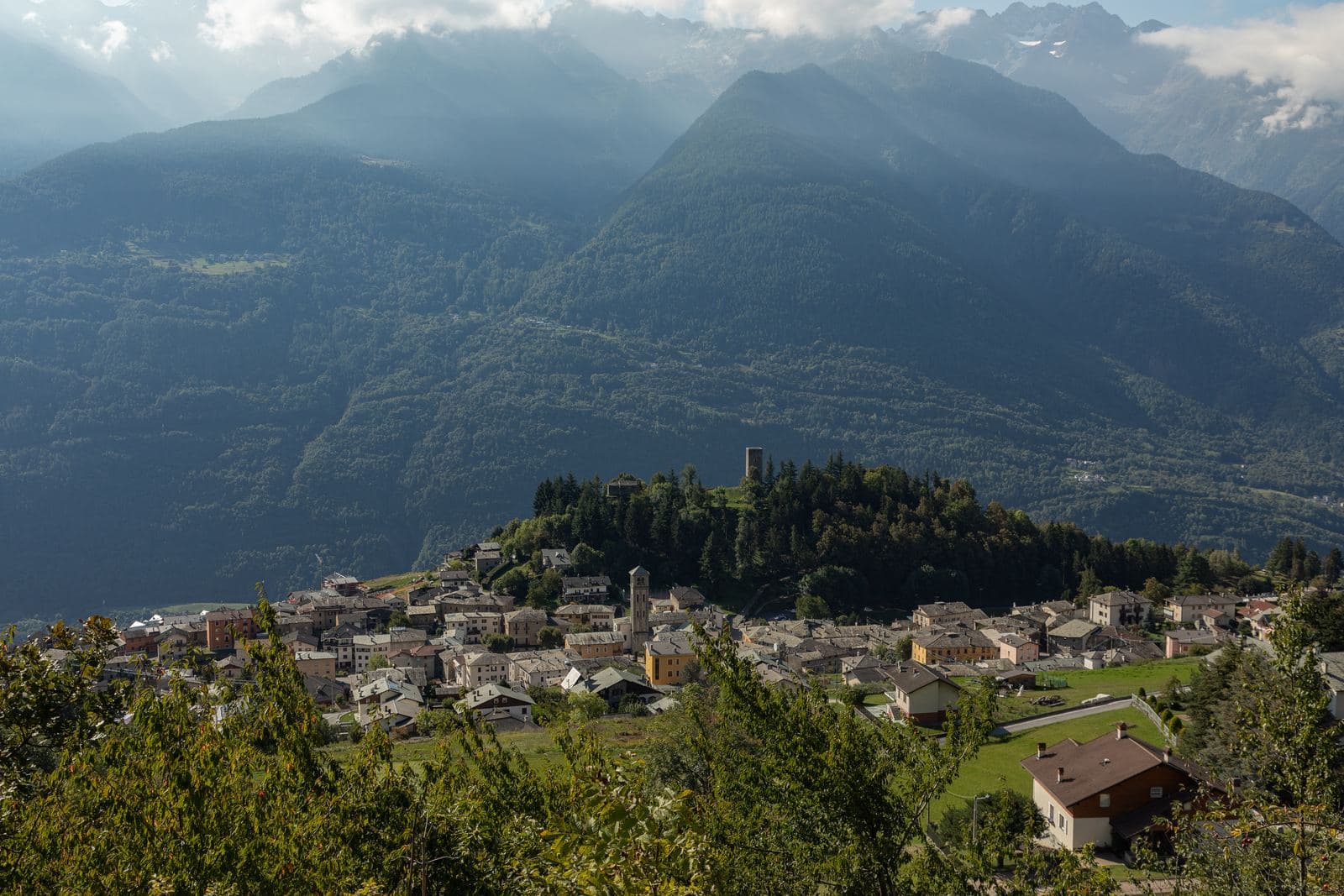
Photo: Maurizio Moro5153 · CC BY-SA 4.0

The route
- Length
- 54.2 km
- Duration
- 2 h 51 min
- Ascent
- 924 m
- Descent
- 924 m
- Highest point
- 858 m
- Lowest point
- 351 m
- Difficulty
- Demanding · Very good fitness
- Surface
- Paved road
Route data and track are provided by Komoot and are indicative: ascents, elevations and times are estimates. Before setting out, always check the route, difficulty, conditions and any seasonal or temporary closures.
A 54-kilometre loop from Tirano, through Teglio and Chiuro: about 920 metres of ascent, almost all on asphalt, with a stretch on a cycle path.
A loop of 54 kilometres starting from Via Valorsa, in Tirano, straight from the saddle. The ride links Tirano, Teglio and Chiuro and returns to the starting point. The highest point is at about 860 metres and the lowest at about 350. On Komoot it is rated hard, with about 920 metres of climbing and a stated time of about two hours and fifty minutes. The surface is almost all asphalt, and about a third of the route runs on a cycle path.
From Tirano: distance, driving time and day trip
The route starts from Via Valorsa, in Tirano, and you can set off straight from the saddle: no car needed. In the evening you return to restaurants, shops and a good dinner.
How to get there
The starting point is Via Valorsa, in Tirano, also reachable by train. The Komoot map can be followed straight from the page: save the route offline before setting out, as the mobile network may be missing.
How to ride it
Carry water, food and a spare inner tube. It is a shorter ride than the great passes, but with an amount of climbing not to be underestimated: choose it with stable weather. Check conditions and orders before setting out.
Places of interest along the route
Along the route, or no more than 500 metres from it, you meet these places. The kilometres are approximate and counted from the Via Valorsa start.
Around kilometre 2, about 280 metres from the route: Palazzo Salis. A 17th-century noble residence in the heart of Tirano: Baroque portal, ten frescoed rooms, a chapel and one of the very few Italian gardens in the Alps, waiting to be discovered.
Around kilometre 14: La Perla di Marco Triacca. Three and a half hectares laid out along the contour in Valgella, Nebbiolo and Pignola Valtellinese, a vineyard planted by the father in the eighties and a name that is a mother's nickname.
Around kilometre 15, about 250 metres from the route: Sandro Fay. Since 1973 the Valgella told vineyard by vineyard: fifteen hectares between 350 and 900 metres, soils of crumbled granite and eight wines that bear the names of their crus.
Around kilometre 19: Balcony of Valtellina. A sunlit terrace above the valley, a medieval tower, a Renaissance palace and the dish that travelled the world: pizzoccheri, guarded by an Academy.
Around kilometre 30: Folini. Nine hectares in thirty plots between Chiuro and Teglio, a barrel cellar in the medieval village, an agriturismo with Florinda's fresh pasta and the stories of Grandma Caterina, born in 1921.
Around kilometre 30: Nino Negri. Since 1897 the most historic wine house of the valley: a fifteenth-century palace in Chiuro, cellars on four underground levels and two and a half thousand kilometres of dry-stone walls to tell about.
Around kilometre 30, about 130 metres from the route: Balgera Vini. Since 1885 in the villa of Maurizio Quadrio, Mazzini's patriot: five generations of wine, stone vaults and a cellar in the heart of Chiuro.
Around kilometre 30: Aldo Rainoldi. Since 1925 a family of winemakers in Chiuro: the Sfursat that matures in the Ca' Rizzieri fruttaio, the Sassella, Grumello and Inferno crus and a programme to adopt a vineyard.
Around kilometre 40, about 310 metres from the route: Casa Vinicola F.lli Bettini. Since 1881 the same family, the same vineyard: the historic Spina in Valgella, cellars carved into the rock and a wine that in the twentieth century crossed the Alps to Davos and Klosters.
Around kilometre 54: Basilica of the Madonna di Tirano. The Renaissance sanctuary born from an apparition in 1504: stucco, wood carving and an extraordinarily rich 17th-century organ, to be admired at leisure.
Before you go
Check the weather, the road conditions and any seasonal or temporary closures of the passes. Carry a helmet, water, food, a spare inner tube, a windproof jacket and a charged phone: the single emergency number is 112. Respect the Highway Code, use lights in tunnels and keep to the right.
Gallery
Photo: Dario Crespi · CC BY-SA 4.0