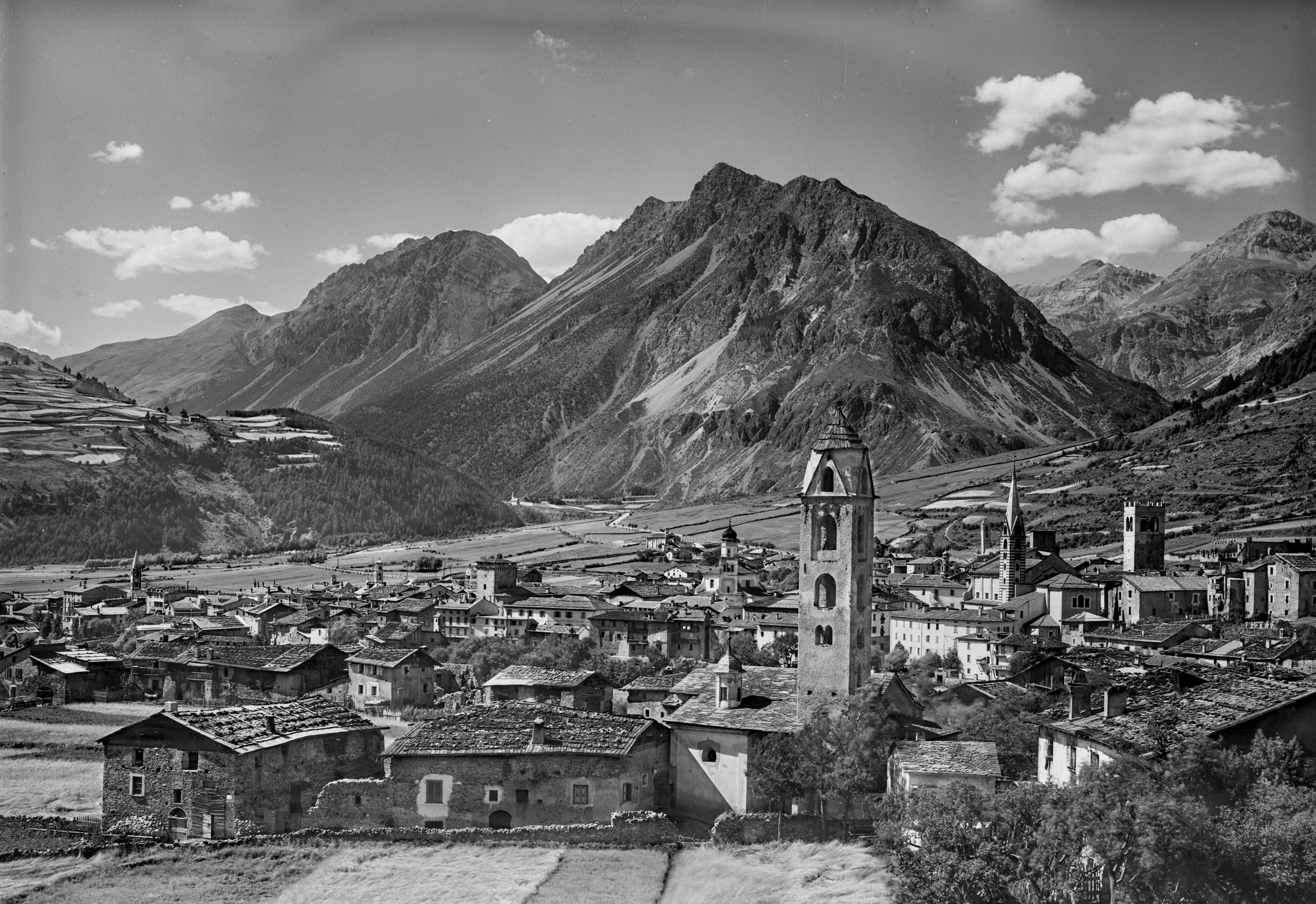
Bormio and its history
The Magnifica Terra: a small mountain republic of hot springs, towers and privileges, which for centuries made history in its own way.
13 min read
Some towns seem built to be seen from afar, and others reveal themselves only up close. Bormio belongs to a third category: towns you listen to. All it takes is to stop in the Kuerc square on a winter morning, when your breath makes clouds and the bell tower strikes the hour, to feel that beneath the porticoes and towers runs a long and proud history. This is the story of the Magnifica Terra, as its inhabitants called it, and as it still likes to be called: a luminous basin at 1,225 metres, surrounded by four valleys and a ring of mountains, which for centuries was a miniature state, with its own laws, its own podestà and its own privileges.
A name that warms: the water and the first document
The name itself tells of the place. Bormio most probably derives from the Gaulish word "bormo", hot spring, or from the German "warm": like the thermal waters that gush from the mountain and that Pliny the Elder was already mentioning in the first century AD. There are three bathing establishments today: the Terme di Bormio, within the municipal territory, and the Bagni Nuovi and Bagni Vecchi, in the hamlet of Premadio, in the neighbouring municipality of Valdidentro. It is the Bagni Vecchi that offer one of the Alps' small botanical secrets: along the rock face below, where the hot water runs off, grows a colony of maidenhair fern, a delicate fern that finds here its highest colony in Europe. And in the park of the Grand Hotel Bagni Vecchi grows a small colony of Swiss stone pines, unique outside the Swiss valley.
Bormio is first mentioned in ancient documents in a letter by Cassiodorus, minister of the Gothic kings; and traces of human settlement in the area go back to the fifth century BC, when someone carved a bas-relief that has been found. But it is in the Middle Ages that the history of Bormio picks up pace. Bormio was a crossroads: along the network of paths leading from here, through nearby Valdidentro, into Switzerland, wine and salt passed. It was a hub of trade and of powers.
The Contado: a mountain state
The history of Bormio, for centuries, is the history of the Contado di Bormio: a territory that included the present municipalities of Valfurva, Valdidentro, Valdisotto and Livigno, and was the seat of a jealously guarded autonomy. Despite the attempts of the bishops of Como and Chur to gain control, the Contado maintained its independence for about three centuries, from the tenth to the thirteenth, when it fell under the control of Como. In the thirteenth century the flourishing Alpine town flew the flag of the Lario city, as was customary for subject territories. In the fourteenth century a much more benevolent lord than the Como governors arrived for a short time: the bishop of Chur, who granted the county greater autonomy. Numerous coats of arms remain from that period: according to a count of 1344 there were twenty-one banners of various workmanship, which were also used in battle by the small Bormio army, engaged in the Tyrol alongside the bishop and the Tyrolean count.
In 1335 Azzone Visconti, lord of Milan, conquered Como and took over the territories subject to it, among them Valtellina with Bormio and Livigno; in 1376 the Visconti consolidated their power. The Visconti presence is attested by the biscione, the family's emblem, still visible on the wall of a building in Piazza Cavour. But Bormio never bowed completely: in 1377, with the issuing of the "magna charta of Bormio's liberties", the commune regained autonomy and obtained important privileges. Power was entrusted to the Podestà of Bormio, who represented the higher authority and without whom the communal bodies could not act.
For the next two centuries the Contado stood at the centre of the trade route linking Venice with Northern Europe, and naturally also with Milan. Thanks to its strategic position and the possibility of imposing duties exclusively on goods in transit, Bormio prospered. Around 1400 it had about five thousand inhabitants and as many as thirty-two towers: today fewer than five remain in good condition, but they are enough to sense a town that was, at once, market and fortress. It is historically Ghibelline, that is, close to the Holy Roman Emperor, as the swallowtail crenellation of the Torre Civica in Piazza Cavour shows.
The Kuerc square, and illustrious guests
The heart of this story is Piazza Cavour. Here stands the Kuerc, which dates from the fourteenth century, at the height of the period of autonomy, and was the place where assemblies were held and justice administered: decrees and sentences were posted on its columns. In front, the Collegiate Church of Saints Gervasius and Protasius, mentioned in documents as early as 803, and the Torre Civica. It is a square that needs no explanation: you read it with your eyes.
In the streets around, the great towers and palaces tell of the richest and most influential families. The Torre degli Alberti, also known as the Marioli or Dossiglio tower, from the thirteenth century, in exposed grey stone, hosted Bianca Maria Sforza in 1493, Ludovico il Moro in 1496 and Leopold V of Austria in 1623. Bianca Maria Sforza was travelling to join her betrothed, the emperor Maximilian I of Habsburg. Ludovico il Moro, in 1496, came with his wife Beatrice d'Este to meet the same emperor; and he returned in September 1499, fleeing a Duchy that was now in the sights of French soldiers. Palazzo Alberti housed for generations some of the most influential families, until 1632, when it passed to the Jesuits, who made it a teaching centre for the Contado.
Among the figures who made history, Gian Giacomo Vismara stands out, podestà from 1495 to 1499, courtier knight and privy counsellor to the Duke of Milan. And the very name "Magnifica Terra", or "Magna Terra di Bormio et honorate valli", which identified the whole area, was more than a title: it was a declaration, of a territory circumscribed in its autonomy, proud, since the most distant times, of its own social life.
1487 and the long decline
Prosperity lasted until 1487. That year a Grisons army came down towards Bormio: the troops of the Duke of Milan, Ludovico il Moro, gave up defending the town, which was spared from being sacked by paying a heavy ransom, but lost its monopoly on transit trade. From then on the Sforza granted the Republic of the Three Leagues too the possibility of imposing duties on a par with Bormio. The Contado, between plague and political and military instability, turned towards decline, and in 1512 became a protectorate under the rule of the Three Leagues.
The people of Bormio, however, did not give up their pride. In the seventeenth century, to reaffirm the idea of autonomy, they set the red coat of arms with the white cross beside the Grisons one: a small, almost ironic gesture that told anyone looking who the real masters of the house were. In the seventeenth century Bormio also lived through the sorrows of its time: the Collegiate Church, which had already been rebuilt several times, suffered a devastating fire in 1621 caused by the Spanish army, and its present appearance derives from the seventeenth-century reconstruction.
Napoleon, Austria and the Stelvio road
With the arrival of Napoleon and the Italian campaign, the independence of the Contado di Bormio also ended. In 1797 the territory was joined to Lombardy and annexed to the Cisalpine Republic. The local historian and priest Ignazio Bardea described the transition as little appreciated by the people: the leaders of the Republic had the town's historic flag removed from the Torre Civica, "a keen expression of an autonomy no longer in being", as Count Lechi said, one of the few Bormio men close to the Cisalpines. In 1802 Bormio passed to the Italian Republic, and in 1805 to Napoleon's Kingdom of Italy. After the Congress of Vienna it fell to the Austrians, who governed until 1859.
The Austrians gave Bormio its most famous road. At the beginning of the nineteenth century the need had arisen for a new road to link the Val Venosta directly with Milan through Valtellina. In 1820 work began on the Stelvio road, entrusted by Emperor Francis I of Austria to the chief engineer of the province of Sondrio, Carlo Donegani, already the designer of the Splügen road. The work employed thousands of labourers and ended in 1825, with the inauguration on 6 July: the Stelvio road, a masterpiece of high-mountain engineering. A stagecoach ran over the pass all year until 1915; in winter, tireless shovellers cleared the road of snow.
In 1859, with the annexation of Lombardy to the Savoy kingdom, the pass became border territory, and the Austrians built three fortifications on the eastern side. In 1928 the route was widened and asphalted. For Bormio, after centuries of trade along footpaths, the Stelvio road meant being connected to the capitals.
When winter is bid farewell: Bormio's traditions
There is a way of knowing Bormio's history that does not pass through books: taking part in its festivals. Bormio's calendar is among the richest in the Alps, and almost every date preserves a very ancient rite.
On 6 January there is the Gabinàt, from the German "geben-nacht", the night of gifts: from the vespers of the eve to those of the Epiphany a contest starts among the population to be the first to greet whoever you meet with the cry "Gabinat!". Whoever has been beaten to it must "pay" by 17 January, the feast of Saint Anthony, by offering simple sweets or a round of drinks. On 31 January the boys appear with the Geneiron, a rite of pre-Christian origin: they drag cans and sheets of metal through the streets to make a racket and wake the spring. On 2 February comes "L'è fora l'ors de la tana": someone is lured out of the house on some ironic pretext and greeted with the words "the bear has come out of its den".
But the best-loved festival is the Carneval di Mat, which dates back to the fifteenth century. For a week, from the feast day of Saint Anthony Abbot, the "mat", the young people of the town, take power and under the Kuerc crown the Podestà of the Mat, who deposes the real podestà of the Contado: for seven days he has unlimited jurisdiction, collects money in the streets, and with a speech "puts on the square" all the awkward secrets of the year. At the end, a great polenta feast for the poor. The Grisons government abolished the tradition in 1755 because it would not tolerate influences on its power, but the protest of the people of Bormio forced it, in 1766, to revise the decree: the Three Leagues did not want to abolish amusements, provided no violence was committed and the Podestà's Palace was respected. It is still repeated today in the proverb "A Sant'Antoni Abat, al salta fora tucc' i mat".
In February there is the Palio delle Contrade, born in 1963: a ski race, traditionally cross-country, between the five historic districts of Bormio (Buglio, Combo, Dossiglio, Dossorovina and Maggiore), with the town's streets filled with snow, and competitors of all ages, up to the over-eighties. And at Easter there are the Pasquali, allegorical religious-themed litters that the five districts build in secret for months and parade: a tradition that comes from the old custom of the sacrifice of the lamb, present, it is said, only in Bormio and Rome.
Snow, glaciers and champions
If in Bormio history has always had to do with hot water, with snow it has had a special relationship. In the 1930s, the CAI of Bergamo had the idea of exploiting the Livrio glacier, on the Stelvio Pass, for summer skiing: it built the Livrio refuge at 3,174 metres to hold the first courses in skiing and ice climbing. After the Second World War, the Stelvio enjoyed growing popularity thanks to Giuseppe Pirovano and his wife Giuliana Boerchio, who at the beginning of the 1950s opened a summer ski school on the glacier.
Then came the great events: Bormio hosted the Alpine Ski World Championships in 1985 and 2005, and its Stelvio piste, from the three thousand metres of Cima Bianca down to the town, is today one of the most famous in the world, and the one that hosted the Olympic alpine skiing races of the 2026 Milano Cortina Winter Games. The town is home to the national federal short-track centre, at the Palaghiaccio Braulio, and has facilities ranging from the Pentagono, one of the largest gyms in the province, to the botanical garden, among the richest in the Alps.
Bormio and the two wars
In the history of the twentieth century, Bormio's position made it a meeting place of the main passes and fronts. In the First World War the area was the rear of a front running along the ridges of the Stelvio: the Stelvio trenches and those in the Forni area, in Valfurva. On the heights of Oga, not far away, Forte Venini was built, one of the best-preserved fortifications of the Great War in Europe, conceived to defend the Stelvio road and the passes from the Austrian threat. But of this history, further on in our journey, there is a chapter all its own.
Strolling through Bormio
Let us close this story with a stroll. You start from Piazza Cavour, between the Kuerc and the Torre Civica, and enter the Collegiate Church of Saints Gervasius and Protasius, where you can admire the seventeenth-century "Lamentation", with its polychrome wooden statues, and two canvases by Giuseppe Prina. A few steps away is the church of Sant'Antonio Abate, or of the Most Holy Crucifix, where an ancient crucifix of the German school is kept, believed to be miraculous: according to legend it took the shape of a cross after being struck by lightning, and a shepherd from Valfurva, sheltering beneath it, completed its sculpting; soldiers are said to have thrown it into the Frodolfo stream, which carried it down to Bormio. In the church of Santo Spirito, attested already in 1304, frescoes remain covering the period between the fifteenth century and the mid-sixteenth. The oratory of San Vitale, from 1196, is a Romanesque jewel, with fourteenth-century frescoes on the façade depicting the emblems of the various craftsmen; the little church of Santa Barbara was built during the Black Death. Palazzo De Simoni, known as "the castle", houses the civic museum.
Those with time can climb to the Bagni Vecchi and Bagni Nuovi of Premadio, where hot water still gushes from the mountain as in Pliny's day. And in the evening, after a day of stories, the best thing is to return to the square, sit near the Kuerc and watch the lights. You will understand why Bormio, for everyone who tells its tale, has always been "the Magnificent": a small land that, through all the centuries, has known how to hold its head high.
From Tirano: distance, driving time and day trip
Bormio is about 35 minutes from Tirano along the SS38 dello Stelvio: a day trip, or an evening in Bormio, with a dip in the thermal baths and dinner, before returning to Tirano, the base from which the whole of Alta Valtellina is within easy reach.