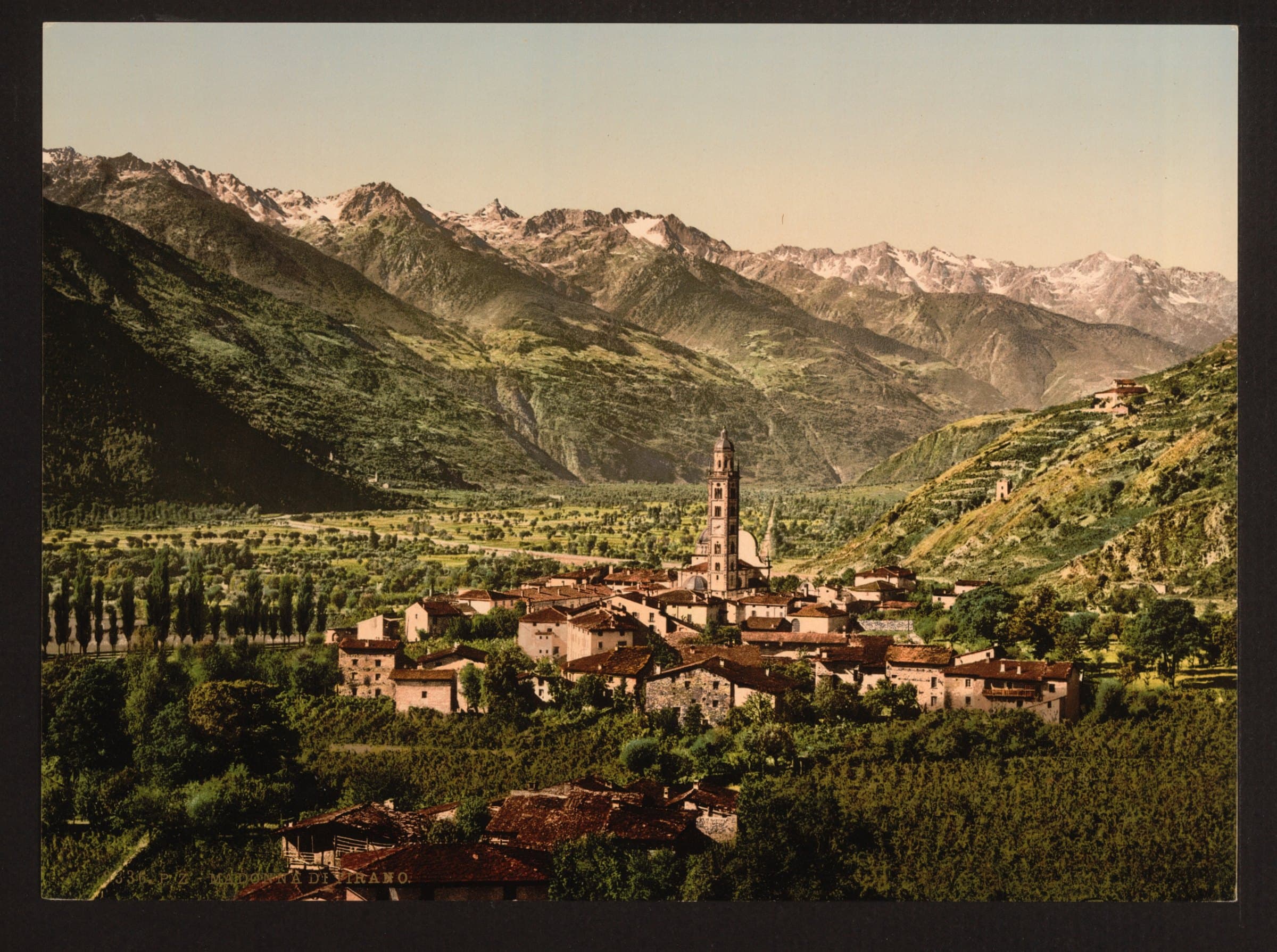
Tirano and its history
The city of the two rivers, the two borders and the Madonna: twenty centuries of stories between Milan, the Three Leagues, Napoleon, Austria and the Bernina trains.
56 min read
If a city could choose its own history, Tirano would have chosen to be born exactly where it was born. Four hundred and forty metres above sea level, in a small basin where the Adda, descended from the glaciers of the Stelvio, meets the Poschiavino coming from Switzerland; to the north the Bernina massif, to the south the Orobie, a few kilometres away the border with the Confederation. Here the valley narrows and then opens, and from here the roads set out in every direction: to Milan by Lake Como, to Brescia and Venice by the Aprica, to Bolzano by the Stelvio Pass, to Sankt Moritz by the Bernina. Whoever held Tirano held an entire region in hand. That is why, over the last two thousand years, everyone has wanted it: bishops and dukes, Swiss and French, Spanish and Austrians. And that is why, walking today among its palaces, its gates and its sanctuary, it feels like crossing an open-air museum in which every stone has a story to tell.
This is the story of Tirano. A story of trade and faiths, of wars and miracles, of trains that climb between glaciers. Read it slowly, perhaps before you set out: it will make you look at the city with different eyes.
The name and the position: a city between two rivers
Where does the name come from? There are three hypotheses, and each has its charm. The most accredited holds that Tirano descends from a certain Tirius, a Roman citizen who owned a plot in these parts: from the Latin "Tirianum" or "Terianum", meaning "of Tirius", the word would then have turned, with time, into the name we know. Another explanation, perhaps too bold, derives it from "inter amnes", "between the rivers", or from "turris amnis", "tower of the rivers": and indeed the city stands precisely between the Adda and the Poschiavino. The most evocative, but also the least accredited, recalls the Tyrrhenians, the legendary people who inhabited Italy before the Romans.
Whatever the origin, the geographical fact remains. For the Valtellinese, Tirano is the first town of the Upper Valley: from here, going up the Adda, one enters the land of Bormio, of Livigno, of the Stelvio. Whoever arrives from the north, from the Bernina Pass and the Val Poschiavo, comes down into Italy here. It is a meeting point and a transit point, and its whole history is here: a city that has lived on roads, and from the roads has received both prosperity and trouble.
The first traces: stones, daggers, Romans
Long before the documents, there are signs. The territory of Tirano was inhabited already in prehistoric times: this is shown by the rock engravings, the daggers of the eighteenth century BC and a Copper Age stele kept at the Antiquarium Tellino. The finds suggest the presence of Etruscans and Celts. But the nucleus of the city, the one from which Tirano as we understand it arises, seems to be of Roman origin: a settlement born at the foot of the Roncaiola slope and spread, already in the imperial age, down to the banks of the Adda.
Imagine this landscape two thousand years ago. There are as yet no palaces, no sanctuary, no walls. There are the sunny slopes, where perhaps the vine is already cultivated; there is the broad river, still free to move; there are the roads that climb from Como towards the Alpine passes, trodden by merchants, soldiers and officials. Tirano is at the point where these roads divide: one climbs towards Bormio and the Tyrol, one crosses the Bernina. The first seed of a border town is already all here.
Lombards, bishops and the Castello del Dosso
When the Roman Empire collapsed, the valley entered a long time of changing hands. Tirano was conquered by the Lombards and then depended on the Diocese of Como, and its fate remained bound to that of the bishops throughout the Middle Ages. Over the centuries the chancelleries of Paris, Vienna, Venice and Madrid took an interest in its strategic position: whoever held the castle and the fortified village held the keys to the Engadine, Lake Como, the Germanic Empire and the Most Serene Republic of Venice, whose borders included the nearby Valcamonica.
The castle in question is the Castello del Dosso, today a ruin that dominates the town from above. It was built on the initiative of the bishops of Como and was documented already in 1140, when it belonged to Bishop Ardizzone, who made it the residence of the Como prelates visiting Valtellina. It then passed into the hands of the noble Omodei family, and became the centre of a larger conflict, that between Guelphs and Ghibellines, between the influence of Como and that of Milan, which was felt bitterly in Tirano too. When the Grisons took possession of the city they dismantled it, and it was never rebuilt: today it lies like a ghost of stone, and for that very reason it lets itself be loved.
In this Middle Ages of journeys and pilgrims, the gentler stones were also born. The xenodochium of Santa Perpetua, dating from the eleventh century, hosted those who travelled from the Milan area and from Venice to Germany; even today its little bell tower dominates the area of the basilica, and the small church preserves early medieval frescoes. Not far away, in Swiss territory, on the sheer rock that looks over Lake Poschiavo, stands the little church of San Romerio, founded at the dawn of the eleventh century as a place of hermitage: built over a very ancient crypt, perhaps already a place of worship in pre-Christian times, in the Middle Ages it was a centre driving the clearing and cultivation of vast wooded areas. Santa Perpetua and San Romerio were unified under a single management in 1234. They are proof that Tirano was never merely a stronghold: it was also a threshold, where people stopped to pray before passing on.
Visconti, Sforza and the walls of Ludovico il Moro
After a brief lordship of the Capitanei di Stazzona, Tirano fell, like all Valtellina, under the Visconti, who became at once lords of Milan and of Como. In 1457 the city had to swear allegiance to the short-lived Ambrosian Republic, then returned to ducal rule under the Sforza, to whom it remained until 1487.
That year a Grisons army, descended from Valdidentro, reached Bormio, which was spared from being sacked by paying a ransom, and headed south, taking Tirano, Teglio and Sondrio. The Milanese troops, after some defeats, beat them in the plain of Caiolo and peace was signed at Ardenno; but the signal was clear. Ludovico il Moro, Duke of Milan, fearing the loss of the city and the territory, set about fortifying it with a circle of defensive walls. In 1488 he sent to Piattamala, a hamlet of Tirano, the architect Giovanni Antonio Amadeo, already at work on the ducal building sites, to proceed with the restoration of the fortifications: the duke had reason to fear the new aggressive policy of the Swiss.
Thus were born the Ludovician walls, which still today surround in stretches the historic part of Tirano on the left bank of the Adda, and the three gates that allowed entry into the city, built at the main commercial and military routes: the Porta Milanese, towards Milan, through which passed those coming from Lake Como or from the Aprica pass; the Porta Poschiavina, towards Poschiavo, the Grisons and the Engadine; the Porta Bormina, towards Bormio and the Stelvio. They are still there, in a good state of preservation, and today it is enough to pass through them to feel the difference between outside and inside, between journey and halt. Above the town, the ruins of the Castello di Santa Maria, familiarly called the Castellaccio, remind us that the city, besides being a place to love, was a place to defend.
The walls were not enough. Ludovico il Moro lost the Duchy of Milan in 1500, and Tirano, with the whole state, passed to the French, who governed it for twelve years.
1504: the Madonna and the farmer
On 29 September 1504, the feast of Saint Michael the Archangel, a farmer of Tirano named Mario Omodei was on his way to one of his vineyards. According to tradition, at a certain point he was miraculously lifted from the ground and carried into a small garden, where the Virgin Mary appeared to him. In those days a plague was striking men and animals, and the Madonna is said to have spoken to him of that scourge and how it would worsen, suggesting as a remedy the building, in that place, of a church in her honour. She also promised him the healing of his brother, already dying of the plague.
Mario returned to the village and told what had happened to him to the knight Luigi Quadrio and the notables of the place. Together with the curate of Tirano, Gregorio degli Omodei, they found that his brother had recovered, went to the garden and decided to build the requested temple. It is said that, as soon as work began, the plague ceased. It was 25 March 1505, the day of the Annunciation of Mary, when authorisation from the bishop of Como to build was received: the first stone was laid that same day.
It is one of those stories in which legend and history intertwine. What truly happened in that garden, nobody can say; what is known is that the place became in a few years a great sanctuary and that Mario Omodei was called "the blessed" by the people, and was remembered as such also by bishops and by two popes, Pius XI and Pius XII, without the Church ever having officially pronounced. The exterior of the building was finished in 1513; for the consecration it was necessary to wait until 14 May 1528, when, the interiors completed, the sanctuary was blessed by the bishop of Como, Cesare Trivulzio.
The most beautiful sanctuary of Valtellina
Whoever enters the sanctuary of the Madonna di Tirano for the first time is left speechless. It is considered the most important religious monument of Valtellina and, with the Duomo of Milan and the Certosa di Pavia, one of the three most beautiful churches of Lombardy. The building, inspired by the Renaissance canons of balance and beauty, was presumably designed by Tommaso Rodari, already architect of the Fabbrica of the Duomo of Como; Tuscan, Lombard and even Venetian elements blend in it, such as the airy façade. Giacomo Rodari, Tommaso's brother, took care of the splendid sculptural decoration of the large windows and side portals, completed around 1534; the main portal is due to Alessandro della Scala da Carona.
Inside, the visitor is greeted by a surprising quantity of stuccoes, paintings and decorations, covering walls and vaults down to the last centimetre. The altarpiece frame, sculpted by the brothers Giovanni Angelo and Tiburzio Del Maino between 1519 and 1524, houses a seventeenth-century canvas that tells of the miracle of the apparition. A monumental organ gallery, made between 1608 and 1617 by the Brescian Giuseppe Bulgarini, rests on eight large columns of red marble. The high altar, in inlaid marbles, dates from 1748; the wooden choir of the apse from 1749. In the first bay on the left opens the chapel of the Madonna, where a statue sculpted by the Del Maino brothers is kept in a marble altar of the early nineteenth century; behind it, a crypt preserves a group of statues representing the scene of the apparition.
Between 1580 and 1587 the dome and the tiburium were built under the direction of the Campione master Pompeo Bianchi, already engineer on the cathedral site of Como; on the summit a statue of Saint Michael the Archangel was placed, the work of Francesco Guicciardi. The bell tower, begun in 1578 and finished in 1641 to a design by Pietro Marni of Bormio, once bore, on the east side, the coats of arms of the three Grisons Leagues, painted by the Valtellinese Cipriano Valorsa: a curious sign of a most Catholic Tirano which, for almost three centuries, had Protestant lords from beyond the Alps as its masters.
The sanctuary has also lived through moments of sorrow. In 1798, during the French occupation, the precious treasure was seized to support the troops and sent to Milan, where it was dispersed; the original wooden altar of the chapel, also by the Del Maino, was requisitioned because it bore silver plaques added at the end of the seventeenth century. And yet devotion did not die out: in 1927 the sanctuary was elevated to minor basilica, Pius XII proclaimed the Madonna di Tirano patron of Valtellina and, on 6 July 2003, Bishop Alessandro Maggiolini raised it to diocesan sanctuary.
The fair of San Michele: when Tirano was the marketplace of Europe
There is a less well-known side of Tirano, but just as important: the mercantile one. After the passage to the Grisons, in 1514, the government granted the city the right to hold in the areas adjacent to the sanctuary a fair, the fair of San Michele. It was a true international fair, lasting two weeks. Merchants came from afar and were lodged, with their goods, in the fondaci, some of which still exist; here the products of Venice, Austria and France were sold, and businessmen from all the neighbouring states met.
Palazzo San Michele, today an elegant residence with a vast porticoed courtyard, with two colonnaded sides and two orders of round-arched loggias, was once the "hostaria granda", annexed to the sanctuary: the place where arriving pilgrims found hospitality and refreshment. Pilgrims and merchants mingled, in a coming and going that made the city rich and gave it a cosmopolitan air unusual for an Alpine town. As so often happens, religion and trade, here, walked hand in hand.
The passage from the French to the Grisons, in 1512, had thus changed Tirano's destiny. While Milan and its duchy passed from one master to another, Valtellina, and with it Tirano, entered the Republic of the Three Leagues, later the Canton of the Grisons. In the following decades the sanctuary became a bulwark of Catholicism against the spread of the Protestant reform promoted by the Leagues themselves: a silent duel, of devotion against doctrine, which would explode, as we shall see, in the seventeenth century.
Under the Three Leagues: three centuries of neighbours from beyond the Alps
To understand the Tirano of the sixteenth and seventeenth centuries one must look a little further north, towards those Grisons valleys from which its new lords came. The Republic of the Three Leagues, or Free State of the Three Leagues, also known simply as the Grisons, was a federation of Alpine communities, among the first examples in the world of a federal system: the Grey League, the League of God's House and the League of the Ten Jurisdictions, which had united to defend themselves better against their powerful Austrian neighbour, determined to control the passes. In the pacts that held them together there were principles surprising for their modernity: all roads were to be open to everyone, a decision taken by two Leagues bound the third as well, disputes between two Leagues found in the third an arbiter, and every year a Diet took the common decisions. The pact, they said, was to hold "as long as the valleys and mountains shall last".
Tirano had a special bond with this world. As early as 1408 the neighbouring community of Poschiavo, which had never had ties with the diocese of Chur, had joined the League of God's House, bringing as a dowry the control of another important pass, that of the Bernina: and the Bernina Pass, from which the Red Train descends today, is precisely the one that links Poschiavo with Tirano. With the Treaty of Fribourg, from 1516, Valtellina and the Counties of Bormio and Chiavenna were assigned, albeit with different levels of subjection, to the Three Leagues, which were allied with the Old Swiss Confederacy. Thus the valley became a subject land, and for almost three centuries its fate was decided in Chur.
The Grisons governed with a system that combined firmness and respect for custom. A large part of local life remained in the hands of the communities: Valtellina was administered by a valley council, with deputies appointed by each community, and Bormio and Chiavenna had their own statute. In 1531 the Valtellinese compiled a unified collection of their laws, which the Three Leagues approved: the Statutes of Valtellina were born. A governor, with a two-year term, represented the Three Leagues in the valleys. But the Grisons lived in poorer territories than a fertile and sunny valley like this, and did not hide it: taxes remained high, the castles, symbol of the ancient local power, were demolished, and the temptation to make Valtellina a true annexed province never faded.
To this was added the problem of faith. The Three Leagues had welcomed the Reformation in the 1520s and 1530s, and in Valtellina the Grisons magistrates protected the Protestant communities, also with the help of Italian refugees fleeing the Inquisition: cultured men, often former clergy, for whom the valleys of the Adda and the Mera were an ideal refuge, lands of Italian language and culture but not subject to the Roman State. From Poschiavo, in those years, the first Grisons printing press distributed Reformed works that reached all of Italy. The majority of the Valtellinese, however, remained Catholic, and it was in this fracture that the bishops of Como, the archbishop of Milan and Spain found their arguments.
The Spanish, for their part, did not stand by. In 1603, don Pedro Enríquez de Acevedo, Count of Fuentes and governor of the State of Milan, ordered the building at the mouth of the valley, at Colico, of an imposing fort, star-shaped, designed by the military engineer Gabrio Busca: work began on 25 October 1603 and ended on 11 June 1604. It was the clearest sign of Spanish aims. The Grisons, allies of the French, tried in vain to prevent its construction by pressing on the borders. When, in 1620, the Sacro Macello broke out, the fort saw its first real use: the Grisons troops were shelled. It remained garrisoned for almost two centuries, until, in 1796, Napoleonic soldiers dismantled it to win the favour of the Grisons themselves.
In this game of powers, Tirano was a prized piece: the city where the interests of those to the north, south and east crossed. It is no surprise that its palaces are so beautiful and its churches so rich.
Saint Charles Borromeo, the Counter-Reformation and a valley that divides
In 1580 an illustrious guest arrived in Tirano. The archbishop of Milan, Charles Borromeo, engaged in the great Catholic reform that followed the Council of Trent, made a pastoral visit to the city and spent an entire night in prayer before the Madonna of the sanctuary, of whom he was a fervent devotee and whom he favoured by every means, as he had already done with the Marian sanctuary of Corbetta. A few years later, in 1589, the bishop of Como, Feliciano Ninguarda, made a pastoral visit throughout Valtellina, and from the records of that journey historians have been able to reconstruct much about life in Tirano at the end of the sixteenth century.
That year something also happened that would leave a lasting mark, almost a wound of the bell tower. The mother church of Tirano, San Martino, until then dependent on the parish church of Villa di Tirano, detached itself from it by an act signed by Ninguarda himself. It was probably one of the reasons that set the two villages against each other for centuries: in 1629 Bishop Lazzaro Carafino granted San Martino the title of collegiate church, establishing once and for all Tirano's primacy over Villa di Tirano, despite the protests of the latter's inhabitants. Those rivalries between neighbouring villages, made of pride and spite, are still today one of the flavours of the valley.
In the meantime Tirano governed itself by its own rules. In 1606 the "Capitoli novi della magnifica università di Tirano" were published for the first time, a set of laws to regulate the life of citizens, on the model of the regulations that had spread in Switzerland. But relations with the Grisons grew ever harsher, above all because of frictions of a religious nature. The new Reformed creed had found a certain diffusion among Tirano's ruling class, while the people mostly supported the Catholic clergy, who feared losing their centuries-old privileges and their influence over the town. The city split along an invisible line that ran through families and, sometimes, through homes.
July 1620: the Sacro Macello
In Valtellina there are pages one would prefer not to tell, and precisely for that reason they must be told with seriousness. The Sacro Macello is one of them. To understand how that night came about we must go back a few years.
In 1617 the Grisons had issued heavy edicts against Catholics. In 1618, at Thusis, a Grisons tribunal controlled by a radical, anti-Spanish Protestant faction tortured and killed the archpriest of Sondrio, Nicolò Rusca, a death that became the symbol of the break between the two communities. In 1619 a Protestant synod met in Tirano, while at Como a Catholic one was being held: an act intended as a provocation. In parallel, the leaders of the pro-Spanish party, Giacomo Robustelli of Grosotto and Giovanni Guicciardi, were preparing the revolt, seeking support from the Duke of Feria, Spanish governor of Milan, from the Duke of Savoy and from the Archduke of Austria. For Spain the stakes were enormous: controlling Valtellina meant opening a corridor between its Italian possessions and those of the Habsburgs of Austria, in the midst of the Thirty Years' War.
It was at Tirano that it all began. In the night between 18 and 19 July 1620 armed Catholic bands, led by Robustelli, moved against the Protestants of the city. From Tirano, in the following days, the violence spread to Teglio, to Sondrio, to the whole valley as far as Morbegno: four, five days of terror. How many died? Estimates vary between four and six hundred people, almost all of the Protestant faith and of Valtellinese origin; among them also some Catholics, killed because they had warned their neighbours or helped them escape. A small group of people from Sondrio managed to save themselves by taking refuge in the Engadine.
The term "Sacro Macello" was coined in 1853 by the Catholic historian Cesare Cantù, who gave that title to his essay on the massacre. Even today that night is an episode that almost all Valtellinese know and remember. It was a tragedy for the victims and their families, and a trauma for the whole valley: hundreds of refugees took the road to the Grisons and Switzerland, finding refuge in the Engadine and at Chur, and then at St. Gallen, Basel, Bern, Geneva; the city of Zurich took in about two hundred and fifty. Others reached as far as Moravia, the Netherlands, the Palatinate.
To look at this page with an unburdened heart means recognising that history, even the dearest, has its shadowed side. And recognising that the Valtellina of today, welcoming and curious, was born also from there: from a time when faith was a banner and banners were made of blood.
The Duke of Rohan at Tirano and the peace of 1639
The Sacro Macello was the beginning of a long war. The Spanish governor of Milan sent troops in support of the Catholics, who soon militarily occupied the valley, bringing the Valtellina corridor back under Habsburg dominion. The Grisons asked France for help; a treaty was signed at Madrid in 1621, and it was disregarded. War resumed: in November 1621 the Spanish, with the Austrians, occupied Chur, and in January 1622 the powers agreed to partition the territory. Venice and the Duke of Savoy tried to overturn the agreement; the pope sent an army to occupy the forts; there was a treaty at Paris, a French invasion in 1624, the peace of Monzón in 1626. Every agreement was followed by a violation. On Valtellina, Madrid, Paris, Vienna, Venice and Rome measured themselves against each other.
In 1635 a new French army, under Duke Henri de Rohan, descended into Valtellina, defeated the Spanish at Morbegno and drove them from the valley. And Rohan chose Tirano as his headquarters: the French commander, a Huguenot Protestant, resided there from 1635 to 1636, and from there moved his armies towards the Spanish territories of Italy, one to Lecco via the Valsassina, the other as far as Abbiategrasso and Varese. For a year, in the little border town, the destinies of the Thirty Years' War on the Italian front were decided.
But 1636 was a calamitous year for France on the other fronts, and Rohan could not exploit the momentum. From 1637 the Grisons, tired of the ally who would not return the valley, negotiated with the Habsburgs: Jenatsch, converted to Catholicism, led three thousand armed men to Landquart and forced Rohan to capitulate. In 1639 the Capitulation of Milan closed the conflict: Valtellina returned to the Grisons on a condition the popes had imposed, namely that only the Catholic confession be tolerated there and that no Protestant, except officials, reside there for more than three months. The Grisons governed the valley until 1797, but the time of persecutions was over.
The palaces and the families: Baroque Tirano
The strategic position guaranteed Tirano, in the sixteenth and seventeenth centuries, a certain prosperity, which can still be read today in its palaces. Walking in the historic centre means passing from one portal to another, from one courtyard to another, with the feeling of having opened a family book.
The most famous is Palazzo Salis, a very clear example of a seventeenth-century Valtellina noble residence. It was built over the course of the seventeenth century (sources place the works between about 1630 and 1690) by Giovanni Salis, governor of Valtellina, on a pre-existing nucleus of the Venosta family. The façade, broad and of late sixteenth-century layout, opens with a rusticated portal that takes up the stylistic features of Tuscan-Medicean architecture, made to a design by Vignola. The interiors, visitable in a museum circuit of eleven rooms, all frescoed and restored, show above all decorative schemes of the Baroque period. The palace also recalls the stay of Giuseppe Garibaldi, who arrived in the city during the Risorgimento operations for the liberation of Valtellina, and another protagonist of the Risorgimento, Count engineer Ulisse Salis.
Not far away, Palazzo Visconti Venosta, now Quadrio Curzio, is an elegant residence of probable Renaissance origin: the central loggia with the three openings of the serliana, the white marble portal, a small porticoed courtyard with stuccoes and friezes. Palazzo Merizzi dates in its layout from the sixteenth century and is famous for two halls lined with carved and painted wooden panels in Louis XIV style, of the seventeenth century. Palazzo Andres, the old palace of the Venosta, is distinguished by the curious monochrome masks painted under the eaves; from here comes the marble well-head of the sixteenth-century well now found in the courtyard of the Visconti Venosta villa-museum in Grosio.
Palazzo Parravicini, on the square of the same name, is the largest in the city after the Salis, but is in a precarious state of preservation. It belonged to a powerful family of Milanese origin, and its history is a small novel. Its last full owner, Giovanni Simone Parravicini (1757-1818), was an ambitious and unscrupulous character: during the brief interlude of the Austro-Russian occupation, between the summer of 1799 and the spring of 1800, he managed to have himself appointed valley chancellor and unleashed a ferocious persecution against the families that had collaborated with the first Cisalpine Republic. When the French returned, the palace was expropriated, turned first into barracks and then, in 1818, into a hospital to treat sufferers of petechial typhus. After 1859 it housed the Royal Carabinieri.
Palazzo Pievani tells another story, that of the mountain. Destroyed by a landslide from Monte Masuccio, it was rebuilt in 1582; it includes the little church of San Giacomo, with its twelfth-century bell tower, the only one to survive the destruction. Today it houses the civic library dedicated to Paolo Arcari. Palazzo Marinoni was born from the merging of several buildings and takes its name from a clergyman who, in the mid-seventeenth century, left it together with a substantial income of a hundred thousand ducats in bonds of the Banco di Sant'Ambrogio so that a gymnasium-lyceum might operate there, which continued until 1798. Since the beginning of the nineteenth century it has been the seat of the municipal administration. Alongside these, the palaces Buttafava, Torelli, D'Oro-Lambertenghi and Quadrio complete a picture that makes Tirano a small capital of palaces.
The churches also tell stories. Sant'Agostino, with a single nave, preserves Rococo trompe-l'œil frescoes and a fine altarpiece; it was attached to an Augustinian convent dissolved in 1652. The oratory of San Pietro, of medieval origin, was the seat of the Disciplini, the brothers of San Pietro; its green stone portal, of 1629, bears the letters "SD" for "Schola Disciplinorum". And the church of San Rocco, at Rasica, has a curious octagonal shape and a novel-worthy story: it is told that Gian Giacomo Medici, the Medeghino, during one of his attempts to seize Valtellina, in 1531 sent to Tirano an emissary disguised as a friar to have built a church-shaped building that was instead to serve as a fortress. The inhabitants, having noticed the deception, rose up, drove out the false friar and completed the construction as a church, dedicating it to San Rocco.
The churches of the centre: San Martino and the others
Before the sanctuary, and beside the sanctuary, Tirano has always had its city churches. The most important is the Collegiate Church of San Martino, the mother church. Anciently it was subject to the parish church of Villa di Tirano, from which it detached, as we have seen, in 1589; in 1629 Bishop Carafino granted it the title of collegiate church. Its origins are uncertain: perhaps a medieval church stood on the same site, of which some visible traces remain, while other studies have traced the origin of the building back to the seventh century. The present structure dates from the mid-seventeenth century, when the church was completely rebuilt from the foundations, incorporating only minimal parts of the previous structure; the façade, instead, is of 1870 and is a design by the celebrated Milanese architect Carlo Maciachini, with the porch frescoes by the Valtellinese painter Giovanni Gavazzeni.
The memory of vanished churches is another story worth recalling: the oldest place of worship in the city, dedicated to Saint Adalbert of Como, no longer exists. And then there are the small churches, those that tell of neighbourhood life: Sant'Agostino, in Via XX Settembre, single-naved, with Rococo trompe-l'œil frescoes and the altarpiece dedicated to Saint Nicholas of Tolentino, co-dedicated to Saint Thérèse of Lisieux; attached to an Augustinian convent dissolved in 1652 with the reform of Innocent X, it first became the chapel of the new school institute founded by Giovan Battista Marinoni, in 1656, then passed to the parish. The oratory of San Pietro, of medieval origin, formerly a place of meeting and prayer of the Disciplini, was later dedicated to Saint Philip Neri in the first half of the seventeenth century; it has a small chapel, some cellars and a grain store, a reminder that faith, here, was wedded to practical life. The little church of San Giacomo, with its twelfth-century bell tower, which survived the landslide that destroyed the nearby palace, today houses a library.
Putting these places together means reconstructing a geography: that of a city that has always joined the sacred and the everyday, the silence of the naves and the noise of the fondaci. A geography that can be walked in an afternoon, on foot, with a little curiosity and without haste.
The eighteenth century, Napoleon and a lost treasure
In the eighteenth century Tirano remained under the Grisons, in a century of relative peace and trade. But already towards the end the first tremors of the French Revolution were felt, with small and large insurrections. On 10 October 1797, with the Treaty of Campoformio, General Napoleon Bonaparte decreed the union of Valtellina with the Cisalpine Republic and of the Grisons with the new Helvetic Republic.
It was, paradoxically, the revolutionary administration that gave Tirano its first stable and functional administrative apparatus: the Tirano area entered the Department of the Adda and the Oglio, and internal connections were improved with the construction of a road linking Colico to Sondrio. But there was also a price. In 1798 French forces seized the precious goods of the sanctuary's treasure, to support the troops, and sent them to Milan, where they were dispersed; with them vanished the original altar of the chapel, requisitioned to seize the silver portions that had been applied to it at the end of the seventeenth century. A shadow on the beauty that the people of Tirano still remember today.
The winter the Masuccio fell: the landslide of 1807
Nature, in this part of the valley, can be unpredictable. On 8 December 1807, because of heavy rains, an enormous landslide came down from Monte Masuccio, the mountain looming over Tirano, and blocked the course of the Adda, creating a barrier forty-three metres high that also threatened the village of Lovero. It seemed the disaster had stopped. But in May of the following year, with the melting of the snow accumulated over the winter, the upper part of that natural dam gave way and rushed down in a torrent, mixed with water, as far as the town of Tirano. The flood swept away vineyards, cultivated land, houses, and destroyed the bridge that linked the city.
It was not the first time the Masuccio had left its mark: in the past one of its landslides had already destroyed Palazzo Pievani. And it would not be the last time the valley had to reckon with rivers that block their own course: almost two centuries later, in 1987, a landslide in Alta Valtellina would do the same to the Adda, with far graver consequences. But that is another story, which you will find told further on in our journey through the history of the valley.
Austria, the roads and the first sparks of the Risorgimento
After the Congress of Vienna, Valtellina and Tirano were annexed to Lombardy and became part of the Lombardy-Venetia Kingdom, whose fortunes they would share entirely. Under the Austrians, despite the rancour of the occupation, the valley knew a period of prosperity. Imperial engineers built roads, improving Valtellina's road network; they fortified the banks of the Adda, protecting the town from possible flooding; they built a Strada Regia that definitively marked the growth of Tirano, which soon found itself at the centre of new commercial outlets towards the Lombard area. It was the season when the Stelvio coach, Donegani's great road inaugurated in 1825, carried travellers as far as Bormio; and Tirano, with its inns and its fresh horses, became an obligatory stop.
The revolutionary uprisings of 1820 and 1848 had almost no effect in these parts. It was a land of mountain folk and merchants, more used to negotiating with armies than to rising up. But news travels in the mountains too. And when, in June 1859, the Franco-Piedmontese victory in the battle of Magenta changed the game across all Lombardy, Tirano did not hesitate. On 6 June 1859 the town councillors voted a document by which the Tirano area was spontaneously annexed to the new Italian state: a pact that was sealed a few days later by the triumphal entry of Giuseppe Garibaldi. His stay, at Palazzo Salis, has remained in the memory of the people of Tirano.
Luigi Torelli, the patriot of Tirano
Among the names Tirano remembers with pride, one has a special place: Luigi Torelli. Born at Villa di Tirano on 9 February 1810, when the valley was part of the Napoleonic Kingdom of Italy, he became one of the protagonists of the Lombard Risorgimento. In March 1848 he was in Milan for the Five Days: it is told that with Scipione Bagaggia he climbed the Duomo to hoist the tricolour. After the failure of 1848 he took refuge in Piedmont, where he was a deputy in Cavour's majority.
In December 1859 he returned to Valtellina as prefect of Sondrio, an office he held until 1872, and in 1861 he founded the Regia Scuola Tecnica there. He was a senator from 1860 and, in 1864, Minister of Agriculture, Industry and Commerce. When he died, in 1887, it was in Tirano, his own land. Even today the square in front of the station bears his name; and the Torelli family left two visible traces in the city: the Baroque Palazzo Torelli, built in the eighteenth century by the Misasi family who owned it before ceding it to the Torelli, and the Torre Torelli, built around the mid-nineteenth century as a structure for raising silkworms. The latter is a small jewel of industrial archaeology: it has medieval gargoyles in the shape of dragons, a bell and a clock that regulated working hours, and testifies to the spread of Neo-Gothic taste in Italy.
Emigrating, leaving, returning
With the proclamation of the Kingdom of Italy, in 1861, Tirano knew a new period of development. But from the second half of the nineteenth century a painful phenomenon also began: emigration. For decades, men and sometimes entire families left the valley for Switzerland, France, North and South America, in search of work. Those who left took with them the dialect, the recipes and the memory of the mountains; many did not return. Today, in Piazzetta Trombini, a monument is dedicated to the Valtellinese and Valchiavenna emigrants scattered across the world: a sculpture that tells of the long farewell and the memory of those who stayed.
That emigration, paradoxically, helped achieve fundamental development goals. Like the railway. The Valtellina railway had been built in stretches between 1885 and 1894 as far as Sondrio; in 1902 the extension wanted by the Società Anonima Ferrovia Alta Valtellina also reached Tirano. It was a mountain railway, built with technical daring: it was part of the system that from 15 October 1902 employed for the first time in Italy, and among the first in the world, high-voltage three-phase electric traction, powered by the Campovico hydroelectric plant. For the people of Tirano, the railway meant Milan a few hours away, and the world suddenly closer.
The Red Train: how the Bernina railway was born
But Tirano's greatest dream did not look to Milan. It looked north. The idea of a rail link with Switzerland, across the Bernina Pass, was born as early as 1899. The first concession application, in December of that year, was submitted by the English company General Water Power Limited. The project was daring: a narrow-gauge railway, electrified from the start, which would have linked Sankt Moritz, in the Upper Engadine, indirectly to Milan. The energy would have come from the hydroelectric power stations built on the waters of Lago Bianco, in the Val Poschiavo: the first to go into operation was that of Brusio, and in the concession deed the clause was expressly included that the electricity for traction would be supplied at a favourable price.
In 1902, when Tirano was reached by the Valtellina railway, the project of a link between Italy and Switzerland became more concrete. In 1905 a referendum in Brusio, Poschiavo, Pontresina and Sankt Moritz gave a largely favourable result. The Swiss federal government approved the project on 2 March 1906; on 1 May work began. To build the line, workers coming predominantly from various Italian regions were employed, and the number of workplace accidents was high: it is right to remember it, because behind the beauty of the viaducts lie the toil, and sometimes the lives, of so many workers.
The sections opened one after another. In July 1908 the Pontresina–Morteratsch and the Poschiavo–Tirano opened. The first Bernina train, with carriages painted a lively lemon yellow (red would come later), arrived in Tirano from the Val Poschiavo in 1908 itself. In July 1909 one could get from Sankt Moritz as far as the Ospizio Bernina. On 5 July 1910 the line was inaugurated in its entirety. At first only summer service was planned, but under pressure from hoteliers, who wanted to exploit the winter tourist season too (an absolute novelty at the time), snow-clearing vehicles were bought in 1912, and from the winter of 1913-1914 the line has been open all year round. The financial difficulties of the construction company were overcome with the intervention of the Banque Sarasin of Basel.
The numbers are an adventure: a single-track line, 60.491 kilometres long, metre gauge; a maximum gradient of 70 per thousand; a minimum curve radius of 43 metres; a highest point of 2,253 metres, at the Ospizio Bernina, which makes it the highest adhesion railway in the Alps. In 1979 it was twinned with the Japanese Hakone Tozan railway, built on the same principle: as a symbol of the twinning, the names of the stations of St. Moritz, Alp Grüm and Tirano are also written in Japanese. And on 7 July 2008 the Bernina railway, together with the Albula, was inscribed on UNESCO's World Heritage list, for the role it played in maintaining links with Alpine settlements in difficult positions, with engineering solutions that harmonise with the landscape.
At Tirano the railway has a peculiarity that is not forgotten. Leaving the station, the train heads west, alongside the sanctuary of the Madonna, crosses the square diagonally and continues along Via Elvezia, in the midst of houses and cars, as far as the bridge over the Poschiavino: a stretch of mixed running where train and city brush against each other. Seeing a red train glide in front of the façade of the sanctuary is one of the images that stays most in the mind of those who visit Tirano. At the station, then, there is a building that tells another story: that of the Dogana, built on the square and handed over to the Customs Receiver on 15 May 1927. It is a sober and elegant building in pre-Rationalist Art Déco style, with reminiscences of historic architecture in the columns that punctuate the triple-light windows, and a strong Alpine connotation in the low pyramid roof covered with slate slabs. Even today it maintains its function as the seat of the Customs Office Directorate and as a station of the Rhaetian Railway.
In a single square there are thus two stations, both termini of two lines that are not connected to each other: the RFI station, terminus of the line to Lecco, run until 1970 by the Ferrovia Alta Valtellina company and then by the Ferrovie dello Stato, and the Rhaetian Railway station, terminus of the line to Sankt Moritz. In a few metres, from the Italian train you pass to the Swiss one, from Italy to the Alps. It is the perfect synthesis of Tirano.
A train journey from Tirano to Sankt Moritz
To truly understand the Bernina railway you have to board it. The train leaves Tirano, at 429 metres, and in about two and a half hours climbs to the highest point, 2,253 metres, before descending into the Engadine. A journey through history as well as landscape, because every bend has a reason.
From the station the red train heads towards the sanctuary, crosses the square and runs along Via Elvezia among the houses, as far as the bridge over the Poschiavino torrent; then it resumes its dedicated track and reaches the state border at Campocologno, where Italy gives way to Switzerland. Going up the Val Poschiavo, the railway crosses the Poschiavino again on a bridge shared with the road, passes east of Campascio and arrives near Brusio, where the line gains height on a viaduct: it is one of the most photographed works of the whole railway, because the line gains altitude with a bold stone architecture that seems designed to astonish. Then comes Miralago, on Lake Poschiavo, where the train skirts the water; then Le Prese and, again in the middle of the road, the village centre; finally Poschiavo, the capital of the valley.
Past Poschiavo the real climb begins. The route gains height with gradients of 70 per thousand, a series of tight hairpins and tunnels; it crosses the Cavagliasco gorge with two almost superimposed bridges, reaches the station of Cadera, then Cavaglia and finally Alp Grüm, where there is a viewpoint worth the journey on its own. After Alp Grüm the railway climbs north and reaches Lago Bianco, which it runs along on the east side. Before crossing the pass there is the station of Ospizio Bernina: the highest point of the line, and of all adhesion railways in Europe.
Then the descent. Along the Val Bernina, the stations of Bernina Lagalb and Bernina Diavolezza are served by cable cars that reach Piz Lagalb and the Diavolezza ski area; further on one meets Morteratsch, with its glacier, and finally Pontresina, from which the Engadine railways branch. The journey ends at Sankt Moritz, beneath the highest peaks of the Eastern Alps. After seeing a train climb to almost two thousand five hundred metres, among lakes that reflect the glaciers, one understands why UNESCO decided to protect it. And one understands too why so many people of Tirano watch it leave, every morning, with the affection of someone waving goodbye to an old friend.
Two wars and a border
When the First World War broke out, Tirano found itself in a particular position. It was not the front line: the front ran along the ridges of the Stelvio and the Ortles-Cevedale, many kilometres and many altitudes above the city. But it was a border town, a few kilometres from neutral Switzerland, in a valley that lived the war from close by. Tirano, which long hosted a battalion of Alpini, knew that world of black feathers and mule tracks well. Many of its young men left; not all returned.
The twentieth century held far more complex pages for the city as well. In 1943-1945, because of its proximity to Switzerland, Tirano became a crossing point for Jews (men, women, children, the elderly) who from Italy tried to cross the border clandestinely to escape racial persecution. For very many, in particular for the some two hundred and fifty Croatian Jews interned in nearby Aprica, it was the way to freedom.
One of these stories is that of the Ascoli and Grünfeld families. They arrived in Tirano on 1 December 1943 and agreed with some smugglers to reach Campocologno, in Swiss territory. In the night of 2 December, walking by night along a path linking Valtellina to the Valposchiavo, Vittoria Ascoli, forty-three years old, mother of Paola and Luciano and wife of Renzo, slipped and fell into a ravine, near boundary stone number 3. The Swiss guards recovered her body the next day; the funeral was held at Campocologno on 5 December. Her husband and children, interned first at Samedan and then near Zurich, managed to save themselves. To the Valposchiavo, during the conflict, about a thousand Jewish refugees arrived; between the two waves, one after the armistice of 8 September 1943 and one after the start of deportations by the Social Republic, many people found help in priests, officials and smugglers.
For Valtellina, the last chapter of the war was that of the so-called "republican Alpine redoubt": the Italian Social Republic had thought of making the valley the last stronghold, gathering all its forces there. The plan was never carried out: nothing concrete had been prepared, and the military and paramilitary apparatus of the RSI gradually dissolved in the first days of May 1945. The war was ending. In Tirano, as in the whole valley, the time of reconstruction was beginning.
The city of the smugglers
There is a Tirano that does not appear in the textbooks, and it is the Tirano of night paths. Because of its proximity to the areas of Switzerland, Tirano was for centuries a border town in the most earthy sense of the term: a city of spalloni, the smugglers who carried heavy sacks on their shoulders across the most remote passes. In the nineteenth and early twentieth centuries mainly salt and tobacco were carried, goods under a state monopoly; during the war, with the collapse of the lira, it became worthwhile to take foodstuffs, rice in particular, and basic necessities into Switzerland. After the conflict, with reconstruction and growing prosperity, the valley became a crossroads for this trade: cigarettes and liquor, then electronic appliances and clothing.
Smuggling was not condemned by popular conscience: many saw in it a way to resist economic hardship and strict customs rules, and a real myth grew up around the spalloni. It is said to have helped curb emigration and keep the local economy alive in difficult periods. The path is said to climb from Tirano through Baruffini and the hamlet of Piazzo to the Val Poschiavo, then follow a cart track to the border near Sasso del Gallo, where the former Guardia di Finanza barracks stands, at 1,239 metres, now abandoned. Clashes between spalloni and finanzieri on the paths above Tirano continued until the 1960s. Then, from the 1970s, the phenomenon slowly declined: with European integration and the single market goods stopped costing so much more across the border, and smuggling dwindled. Today those same paths have become routes for hikers, and the stories of the smugglers are told in local museums.
From the boom to today
After the two world wars Tirano knew, in the 1950s and 1960s, the economic boom. Little by little a tourist vocation also developed: the position, a step from the great summer and winter mountain resorts, and the draw of the sanctuary and the Red Train did the rest. The summer of 1987 was a harsh test for this part of the valley too. The flood that struck Switzerland, with the overflow of the Poschiavino, affected wide areas as far as Tirano; the Piattamala customs post was declared unusable, the railway on the Morbegno-Tirano stretch was damaged and service was suspended and then reactivated. That year, for Tirano, was above all a time of waiting, in an emergency that was playing out upstream, in Alta Valtellina. But also a lesson: the river does not forgive those who forget it.
Today Tirano is a quiet and welcoming city, halfway between history and journey. Glances arrive from all over the world: those of the pilgrims who climb to the sanctuary, especially on days linked to the story of the apparition and the foundation; those of the tourists who descend from Sankt Moritz on the Red Train and find themselves in an Italian square where dialect is spoken and the air smells of pizzoccheri. Wine lovers arrive, for the terraced vineyards of the Rhaetian side dominated by the hamlets of Baruffini and Roncaiola, where Sforzato is also produced, a wine obtained from grapes left to dry on racks. And gourmets arrive, for the traditional dishes: black polenta, sciatt, pizzoccheri, chisciöi, cheeses and cured meats, and the apples of the Orobie side. In the city pewter is also worked, from which art objects, jewellery, trophies, trays and plates are made.
The Giro, football and pewter: Tirano today
The history of a city does not end in books: it continues in streets, squares, sport. Tirano has a passion that has crossed the decades, that for cycling. On 10 June 1967 the city hosted the finish of stage twenty-one of the fiftieth Giro d'Italia, the Trento–Tirano, won by Marcello Mugnaini; the next day it hosted the start, towards the Madonna del Ghisallo, with the victory of Aurelio González. Since then the pink race has returned several times: in 1991 with the start of the stage towards Selva di Val Gardena, won by Massimiliano Lelli; in 2005 with the start from Villa di Tirano towards Lissone, won by Alessandro Petacchi; in 2008 with the finish of Emanuele Sella; in 2011 with that of Diego Ulissi; in 2015 with the start towards Lugano, won by Sacha Modolo; in 2017, in the centenary edition, with the start towards Canazei, won by Pierre Rolland. The women's Giro Rosa too, in 2016, ended a stage in Tirano, with the victory of Mara Abbott, and the handbike Giro d'Italia made a stop there in 2023. For a small mountain city, a fine story of wheels.
Football, by contrast, has a more discreet face. The local team, the Unione Sportiva Tiranese, was founded in 1919 and has never gone beyond local amateur championships: but this, in a city where people play for passion, has made it a neighbourhood institution.
And then there are the trades. In Tirano the working of pewter is widespread, a metal alloy from which artistic objects, jewellery, trophies, trays and plates are made: a craft visible in the shop windows of the centre that tells of the Valtellinese ability to give beautiful form to humble materials. Like the products of the land: cheeses and cured meats, the apples of the Orobie side, the wines of the Rhaetian terraces and the dishes based on buckwheat, black polenta, sciatt, pizzoccheri, chisciöi, which are the cuisine of the city.
Museums and memory: where history can be touched
Those who want to touch Tirano's history have many possibilities. Palazzo Salis, with its museum circuit of eleven frescoed and restored rooms, lets you enter a seventeenth-century noble house and understand how the governors and families who, between Grisons and Spanish, administered the valley lived. The Museo Etnografico Tiranese tells of everyday life, trades, the tools of those who worked the land and the vineyard. The Casa-Museo D'Oro Lambertenghi preserves the atmosphere of a gentleman's residence, with its furnishings. At the Antiquarium Tellino you can see the Copper Age stele that recalls how the history of these lands began long before the Romans.
A few kilometres away, in Grosio, the Villa Visconti Venosta houses the municipal museum, and the Park of Rock Engravings of Grosio and Grosotto tells, with the Rupe Magna, the story of the valley's first peoples: an ideal complement for those wishing to lengthen their journey. And in Switzerland, a short distance away, the little church of San Romerio, with its very ancient crypt, can be reached on an excursion from Tirano along the road that from Baruffini passes above Sasso del Gallo: its sheer façade has been made safe by a complex Italo-Swiss project involving engineers, historical researchers, archaeologists and the University of Milan, financed with European Interreg funds and with money raised by a dedicated Foundation. Ownership of the building is held by the Commune of Tirano, while worship is the responsibility of the parish of Brusio: a small but eloquent symbol of a border history in which, for a thousand years, things have been done together.
Tirano seen by early photographers
There is one more way to reconstruct the history of Tirano: to look at it through the images of those who saw it change. The photochrom prints of the late nineteenth century, printed with a colour lithographic technique that gave landscapes the air of a dream postcard, show the sanctuary with its dome and bell tower still immersed in meadows. The woodcuts of the panoramas of 1895 tell of the cities like an illustrated encyclopaedia: Tirano, Bormio, Santa Caterina Valfurva. In 1924 Leo Wehrli, a Swiss photographer, walked through the alleys of Tirano photographing old houses and covered lanes, images now kept in the archives of the Federal Polytechnic of Zurich. And between 1925 and 1928 another Swiss, Walter Mittelholzer, a pioneer of aviation, flew over Valtellina and photographed Tirano and the Madonna di Tirano from above: from two or three hundred metres up, you see the city as it was, a compact nucleus of roofs, surrounded by fields and vineyards.
Looking at these images beside those of today is a fascinating exercise. The shape of the city is the same: the sanctuary to the west, the river, the terraces to the north. What has changed is the outline, the asphalt, the cars. But the heart, for those who look for it, can still be found.
The landscape that made history: the terraces, the river, the mountain
A history of Tirano would not be complete without looking at what lies around the city. Because part of its identity is made of earth: of those sunny slopes that rise to the north, on the Rhaetian side, and that for centuries were patiently transformed into terraced vineyards. They are the terraces dominated by the hamlets of Baruffini and Roncaiola: dry-stone steps, built one after another by the hands of people who had little land and much patience, on which ripens a grape that produces renowned wines, among them Sforzato, made from bunches left to dry on racks.
Walking among these walls means reading history on the ground. Here the sun arrives for many hours a day, and the first Roman settlements spread precisely at the foot of the Roncaiola slope; here the farmers who in 1504 brought their devotion to the sanctuary cultivated the same vines; here the smugglers climbed, by night, the paths towards Switzerland. On the opposite side, that of the Orobie, apples and woods dominate instead. In between, the river: the Adda, which has changed its bed several times in this area, and the Poschiavino, which at Tirano flows into the larger river. And above, the mountain: Monte Masuccio, which on a December day in 1807 broke away onto the Adda; and the Dosso, with the ruins of the Omodei Castle; and the Castellaccio, the tower of Santa Maria, recently restored.
Palazzo San Michele, the sanctuary square, the Ludovician walls and their three gates, the stepped vines: all this holds together. The history of Tirano is also a history of agricultural ingenuity and water.
The coat of arms, the flag, the words
Every city has its symbols, and those of Tirano tell its history at a glance. The city's coat of arms was granted by decree of the President of the Republic of 21 April 1999. The castle is a probable allusion to the circuit of the Sforza fortifications, those of Ludovico il Moro; the eagle recalls the ancient feudal ties of imperial derivation and is also present in the coat of arms of the Visconti Venosta family, one of the great families of the area.
Words too have an origin. For the Valtellinese the city is called Tiràn; in Romansh, Tiraun; in German, in a now obsolete usage, Thiran. They are three ways of saying the same name, and they remind us that Tirano has always been a city of many voices: Italian-speaking but facing the Romansh and Germanic world, used to living with neighbours who spoke another language. It is a characteristic still felt today in its markets and its stations.
Hamlets and borders: Villa, Piattamala and the others
Tirano is not only the city seen from the railway. Around the historic nucleus are the hamlets, each with a history. Villa di Tirano, the neighbouring rival whose primacy we have discussed, is the birthplace of Luigi Torelli and for centuries was the seat of the parish church from which San Martino detached: a bond of blood, so to speak, and of bell tower. Piattamala, on the road that climbs towards the border, is the place where in 1488 the architect Amadeo was sent to "restore the fortifications" at the duke's wish; and it was, for a long time, the site of the Italian customs post, which a flood of the Poschiavino made unusable in 1987. Baruffini and Roncaiola, on the northern slopes, are the villages of the vineyards, whose terraces are among the most evocative of the valley. Higher up, Sasso del Gallo, at 1,239 metres, with its old, now abandoned Guardia di Finanza barracks, is the outpost of the border.
These names are not casual: they tell, one by one, the reasons of the city. Defence, trade, the vine, the border. Whoever climbs today towards the Val Poschiavo by car, by train or on foot passes the same places through which, over the centuries, soldiers and merchants have passed.
A walk through the history of Tirano
There is no better way to know the history of a city than to walk it. Here is a one-day route, following the thread of this story.
Start from the station square, where the two tracks, the Italian and the Rhaetian, stop a few metres from each other. Observe the Dogana building, with its slate roof, and remember that the square bears the name of Luigi Torelli. Then walk towards the sanctuary: the airy façade, the portal of Alessandro della Scala, the dome of Pompeo Bianchi, the sculptures of the Rodari. Go in, sit down, look at the ceiling: it takes ten minutes to understand how much art has been put together. Come out and pass under the bell tower, thinking of the coats of arms of the Three Leagues that were once painted there. Palazzo San Michele, next door, will show you the old pilgrims' courtyard.
From here enter the historic centre by the Porta Poschiavina or the Milanese one: beneath you, the same stones on which the merchants of the fair of San Michele passed. Visit Palazzo Salis with its eleven frescoed rooms; admire the façade of the Collegiate Church of San Martino, of 1870, designed by the Milanese Carlo Maciachini, and the porch frescoes by Giovanni Gavazzeni; peek into the church of Sant'Agostino, with its Rococo trompe-l'œil; look for the inscription "SD" on the portal of the oratory of San Pietro. If you like museums, the Museo Etnografico Tiranese and the Casa-Museo D'Oro Lambertenghi tell of the daily life of times past.
In the afternoon climb towards the vineyards, at Baruffini and Roncaiola, and look at the city from above: from up here the two stations are small as toys, the river is a silver thread, the Castellaccio a shadow on top of the hill. Those with legs can continue on the smugglers' path to Sasso del Gallo, and even venture to the little church of San Romerio, on the rock above Lake Poschiavo. And in the evening, back in the square, with a plate of pizzoccheri before you and the whistle of a red train leaving for Switzerland: you will understand why Tirano, after two thousand years, has never ceased to be a place one departs from and returns to.
Essential chronology
Before history: rock engravings, daggers of the eighteenth century BC and a Copper Age stele, found in the territory of Tirano.
Roman age: the original nucleus of the city is born at the foot of the Roncaiola slope and extends to the Adda.
568: the Lombards conquer Valtellina; the area will then depend on the Diocese of Como.
Eleventh century: the xenodochium of Santa Perpetua is born for wayfarers and pilgrims bound for Germany.
1140: the Castello del Dosso is already documented, property of the bishop of Como Ardizzone.
1335: Azzone Visconti conquers Como and, with it, Valtellina.
1457: Tirano swears allegiance to the Ambrosian Republic; then returns to the Sforza.
1487-1488: the Grisons occupy Bormio and descend as far as Tirano; Ludovico il Moro has the city fortified with walls, with the architect Giovanni Antonio Amadeo.
1504: on 29 September, according to tradition, the Madonna appears to Mario Omodei.
1505: on 25 March work on the sanctuary begins; the exterior is finished in 1513 and the sanctuary is consecrated on 14 May 1528.
1512: Valtellina passes to the Grisons.
1514: with the authorisation of the Grisons government the international fair of San Michele is held in Tirano.
1526: the Grisons have the valley's castles demolished.
1580: Saint Charles Borromeo visits Tirano and spends a night in prayer at the sanctuary.
1589: San Martino detaches from the parish of Villa di Tirano.
1606: the city's "Capitoli novi" are published.
1618-1619: Nicolò Rusca dies; a Protestant synod is held in Tirano.
1620: in the night between 18 and 19 July, in Tirano, the Sacro Macello begins.
1629: San Martino becomes a collegiate church.
1635-1636: the Duke of Rohan sets up his headquarters in Tirano.
1639: the Capitulation of Milan returns Valtellina to the Grisons, on condition that only the Catholic faith is tolerated.
1797: the Treaty of Campoformio joins Valtellina to the Cisalpine Republic.
1798: the French seize the sanctuary's treasure.
1807-1808: the Masuccio landslide dams the Adda and, in May, the flood destroys the city's bridge.
1815: Valtellina enters the Lombardy-Venetia Kingdom.
1859: on 6 June the Commune resolves on annexation to the Italian state; Garibaldi arrives.
1861: the Kingdom of Italy is born.
1902: the Valtellina railway reaches Tirano.
1908-1910: the Bernina train arrives in Tirano (1908) and the line is inaugurated in its entirety on 5 July 1910.
1927: the sanctuary is elevated to minor basilica; the new station Dogana is handed over.
1943-1945: Tirano is a crossing point for those fleeing towards Switzerland.
1967: the city hosts the finish and start of two stages of the Giro d'Italia.
1987: the flood strikes Valtellina and Switzerland, and the Poschiavino overflows as far as Tirano.
2008: the Bernina railway is declared a UNESCO World Heritage Site.
Why come to Tirano
One can come to Tirano for many reasons. For the red train that leaves from the square, for the mountains that surround it, for the wine, for the table. But there is one more reason, which all the others contain: because here time has not passed in vain. Every corner has a story to tell, and it is enough to stop a minute to hear it. In a city of fewer than nine thousand inhabitants you meet in a few steps one of the most beautiful sanctuaries in Lombardy, a Baroque palace with eleven frescoed rooms, three gates of Renaissance walls, the track of a train that is a World Heritage Site and the mountain path the smugglers walked by night. It is no small thing.
When you board the train again, or come down from the mountain, look at it once more: the Adda, the Poschiavino, the sanctuary, the Castellaccio on the hill. You will see a city that has never ceased to be a threshold. And you will understand why, after two thousand years, people still stop here.