The history of hydroelectric power in Valtellina
How glacier water became light: from Milan's challenge to Edison to the dams of Cancano, the great adventure that changed the face of Alta Valtellina.
12 min read
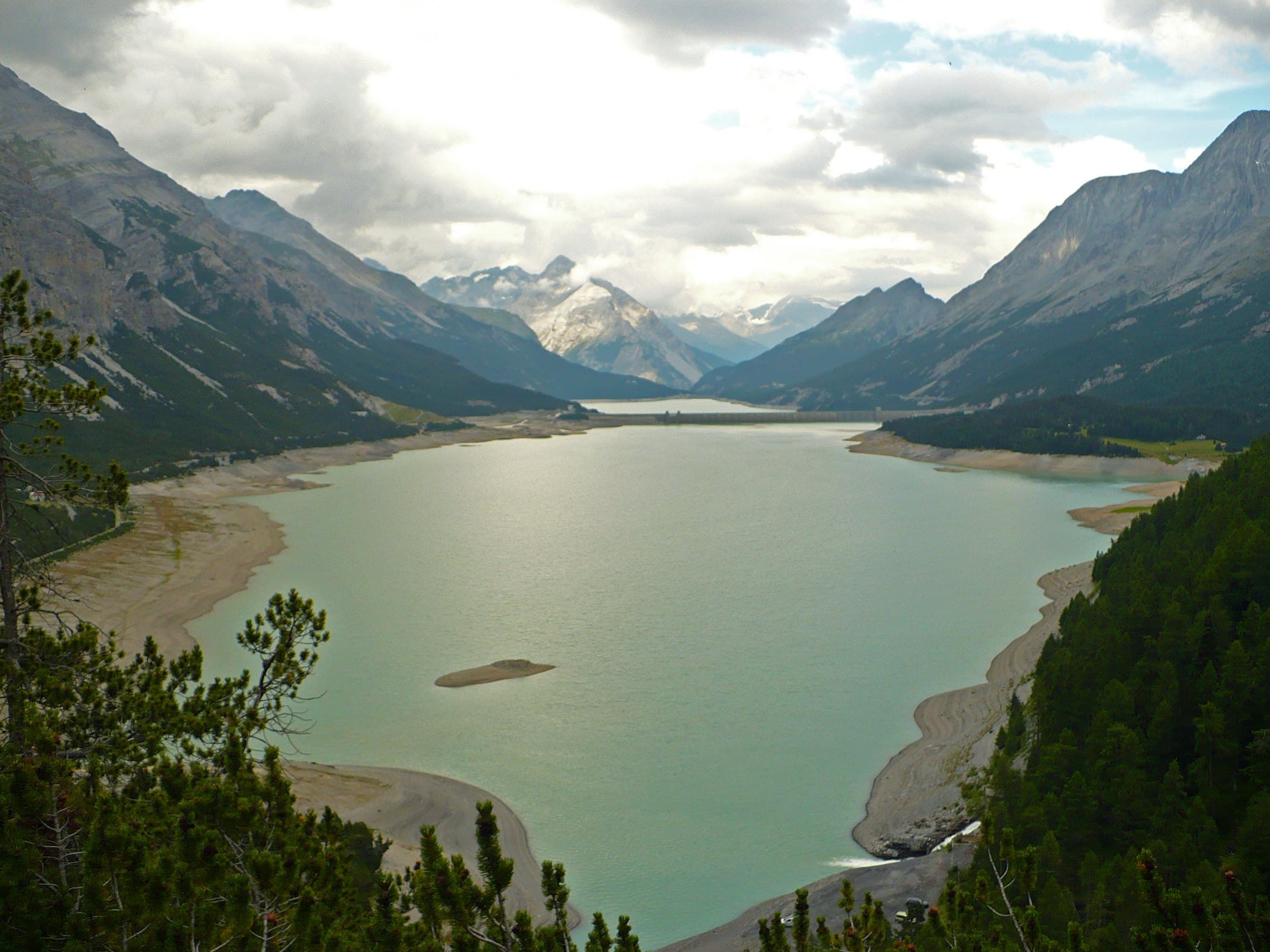
Whoever climbs today to Lake Cancano, in the Fraele valley, finds one of the most evocative landscapes of Alta Valtellina: a broad stretch of deep blue water set between rock walls, with the medieval Torri di Fraele standing guard at the entrance. It seems a lake like any other, as old as the mountains. It is not. It is a lake built by man, the result of one of the greatest feats of Italian hydroelectric engineering, and behind its tranquil surface lies a story of concessions, political rivalries, famous architects, tunnels dug into the heart of the mountains and waters that, for over a century, have turned the glaciers of the Stelvio into light for the cities. It is the story of hydroelectric power in Valtellina.
The Adda, a river at work
To understand why Valtellina became one of the capitals of hydropower, you only need to look at the river. The Adda rises in Alta Valtellina, not far from the Fraele valley, on Monte Ferro, and after gathering the waters of the torrents it flows down towards Tirano, Sondrio and Lake Como. It is a capricious river: its flow can fall to a few cubic metres per second in the driest months and exceed a thousand in flood, and over the centuries it has changed its bed several times, even in the area of Villa di Tirano and in the Val Pola. But it has an enormous advantage: it starts from very high up and descends with a formidable drop. Every metre of that descent, to an engineer, is potential energy.
Along the Adda, in the lowland villages, the first power stations had already appeared in the nineteenth century and the early twentieth: that of the national linen mill at Fara Gera d'Adda, operating since 1895; that of Porto d'Adda, of 1898; the Taccani at Trezzo, completed in 1906; that of Crespi d'Adda in 1908. They are now examples of industrial archaeology. But the great leap, the one that would transform the mountain, came when it was realised that upstream, where the water fell from a thousand metres and more, lay an even greater treasure.
15 October 1902: the valley of electric trains
Electricity reached Valtellina in an unexpected form: on rails. On 15 October 1902 service began on the Lecco-Colico-Chiavenna line and on the Colico-Sondrio line, with three-phase overhead lines: it was the first in Italy, and among the first in the world, to use high-voltage three-phase alternating current for train traction. The current came from the Campovico hydroelectric plant. A border valley, until then secluded, suddenly became a technological laboratory: technicians came from all over Europe to see the electric trains running along the Adda.
It was an omen. In the same period the Bernina railway, designed from 1899 with electric traction, was being born exploiting the water of Lago Bianco: the first power station to go into operation was that of Brusio, in the Val Poschiavo, and the concession deed provided that the electricity for traction would be supplied at a favourable price. Water, train, mountain: a bond that in this part of the Alps has never been broken.
Milan against Edison: the city's challenge
The fate of that water was not decided in the mountains, but far from there, in the rooms of the Municipality of Milan. Since 1883 electricity in the city had been supplied by the Edison company, from the Santa Radegonda power station, at a tariff of one lira per kilowatt-hour that was the highest of all Italian cities. In 1884 the company had obtained a twenty-year concession for public lighting; the Municipality had until 31 December 1903 to cancel it.
From 1 December 1899 the government of the city was in the hands of the Alliance of the popular parties (radicals, socialists, republicans), which had replaced a moderate bloc in power for about forty years. The municipal technical office, led by engineer Tito Gonzales, prepared three alternatives; a council commission chose the most ambitious. At the end of December 1903 the municipalisation of electricity was approved and Edison was informed. Senator Giuseppe Colombo, founder of Edison, had opposed the national law on municipalisation, number 103 of 29 March 1903.
The city did not merely want to produce electricity: it wanted to produce it publicly and cheaply, and for that it needed water. At the beginning of 1906 the Municipality of Milan obtained the concessions on the Adda between Bormio and Tirano, partly thanks to the transfer by engineer Valmiro Pinchetti. To overcome local opposition, compensation was offered to the municipalities involved. The municipal resolution dates from July 1909; the referendum that ratified it was held on 10 April 1910; and on 8 December 1910 the Azienda Elettrica Municipale, the AEM, was officially born. At that moment the energy of Valtellina was already arriving in Milan.
Grosotto, 1910: the first great power station
The first great work was the Grosotto power station. Work began in the spring of 1907 and ended towards the end of 1910. The water was taken at the Prese, about twelve kilometres upstream, and reached the plant with a drop of about three hundred and twenty metres, producing about twelve megawatts. For that time it was an enormous power. The building was entrusted to a great architect, Gaetano Moretti: the power station was not to be merely a machine, but a work of architecture, a sort of cathedral of energy in which the turbines would be housed with the same care as a work of art.
At the same time a long power line of about a hundred and fifty kilometres, at 65,000 volts, was built, which from Valtellina reached Milan via the Valcamonica and the Val Cavallina: a thread stretched between the Alps and the city. For those living in Milan, the thread of mountain water became light in the streets; and in 1916-1917 the municipal company also took over the management of the trams.
Boscaccia and Roasco: the architecture of energy
After Grosotto it was the turn of the Boscaccia power station: two megawatts, whose works began during the war and which entered service in 1919. Damaged by the flood of 1987, it came back to life in recent times with new units, one of 3.3 megawatts in 2000 and one of 10 in 2004. 1922 was instead the year of the Roasco, designed by one of the great Milanese architects of the twentieth century, Piero Portaluppi: the power station entered service in January of that year with about fourteen megawatts, was enlarged in 1927 and 1934 to exceed thirty-one, and was fed by the Fusino dam. It remained in operation until, in 1960, the Grosio power station went into service.
It is no small detail that two great names of Milanese architecture, Moretti and Portaluppi, were called to design buildings in a mountain valley. The power stations were not merely plants: they were a manifesto. They said that modernity could be beautiful, that engineering could converse with the landscape.
Cancano: the built lakes
But the most spectacular part of this story concerns the lakes. In the upper Fraele valley it was decided to build a barrier. Work on the Cancano I dam, also called the Fraele dam, began in 1921-1922 and ended, according to the sources, between 1928 and 1933: an arch-gravity dam that was to create a reservoir of over twenty million cubic metres of water, feeding the Fraele-Isolaccia power station, whose first fifteen-megawatt unit entered service in 1928. In 1932 a new northern receiving station was inaugurated in Milan for the 130,000-volt line arriving from Fraele.
Soon the reservoir proved insufficient. Before the war, in 1939-1940, work began further upstream on the new San Giacomo dam: construction slowed and then stopped because of the conflict, and was completed and inaugurated in August 1950. It was a true engineering feat, given the building-site means of the time: a buttress dam in the central part, connected to two lateral massive gravity dams, with a crest more than nine hundred metres long, at almost two thousand metres of altitude.
In the post-war period demand for electricity grew rapidly, and the AEM decided to build a new dam: Cancano II, or Fraele dam, whose works began in 1953 and ended in 1956, closing the valley at 1,900 metres with an arch-gravity barrier, 136 metres high with a crest of over 380 metres. The reservoir, with a capacity of 123 million cubic metres, submerged the old Cancano I dam and the old power station fed by San Giacomo. These two works are still sometimes visible when Lake Cancano II is emptied: two concrete ghosts that re-emerge from the water.
Today the two basins, San Giacomo and Cancano, have a combined capacity of 187 million cubic metres of water, collected not only from the Adda, which rises a little higher up, but also from the Spöl canal, which brings water from the Swiss side, from the Gavia-Forni-Braulio canal and from the new Viola Bormina canal. They feed the Premadio power station, in the municipality of Valdidentro.
Stazzona, Lovero, Premadio, Grosio: the cascade of power stations
As the dams multiplied, the power stations too formed a true system: a "cascade" in which the same water, descending from the mountain, is used several times, in successive drops. In 1921 the expansion plan envisaged a series of plants from Viola-Fraele to Isolaccia, and then Cepina, Le Prese, Mazzo (replaced by the Roasco) and Stazzona; Cepina was cancelled in 1928. The Stazzona power station, with its intake at Sernio and a canal of over eight kilometres, entered service in 1938 with 35 megawatts: thanks to it the total power of the Valtellina plants reached about 170,000 kilowatts. The Lovero power station, of 44 megawatts, begun in 1942, was completed in March 1948.
Then came the post-war giants. Premadio, with two 74-megawatt units, entered service in 1956; at the end of 2003 a third unit of 78 was added. The Grosio power station, whose works began in 1956, entered service in 1960 with two 110-megawatt units, which became three in 1964; in 2002 a fourth, of 108, was added. It is a reservoir power station, exploiting the second drop of the Alta Valtellina hydroelectric system, using the waters leaving the Premadio power station, those of the Adda and of several torrents (the Viola, the Frodolfo, the Vallecetta, the Massanigga, the Vendrello, the Migiondo, the Eita, the Sacco), and collecting them in the artificial basin of the Valgrosina, of 1.2 million cubic metres. Four vertical-axis generating units, with four-jet Pelton turbines. In the 1960s Milan was connected to Valtellina by two 220,000-volt three-phase circuits, towards Grosio and Premadio. In 1986, after a long authorisation process, the Braulio power station, of 19 megawatts, also entered service.
The other half of the story: water from Switzerland
There is a detail that makes this system an international story. Among the sources feeding Cancano is the Spöl canal: the water of a river that rises in Switzerland. Further north, in the Livigno basin, in 1965-1968 the Swiss company Engadiner Kraftwerke, following an agreement with the Italian government, bought land to build a reservoir: the Punt dal Gall dam, on the border, with the first impounding of water beginning on 16 October 1968. A few houses and a small church were demolished; Lake Livigno, which today holds about 164 million cubic metres of water, serves as the annual reservoir of the Swiss Ova Spin power station, in operation since 1970. The waters of the mountains know no borders, and hydropower, like the Bernina railway and the smugglers' paths, is another border story.
A landscape to discover
All this, today, can be seen and walked. The Fraele valley is one of the best-loved destinations of hikers in Alta Valtellina: the lakes of Cancano, blue and solemn, with the Torri di Fraele, two signal towers built between 1391 and 1392 at 1,930 metres, guarding the access to the valley; the paths that skirt the dams; the viewpoints from which the landscape is embraced. When Lake Cancano is low, the remains of the old dam and the old power station re-emerge: an open-air industrial archaeology.
Further downstream, the power stations of Grosotto, Roasco and Boscaccia are examples of an "architecture of energy" born of the dialogue between engineers and architects. Between Bormio and Tirano, along the Adda, one can recognise the intake works, the canals, the penstocks running down the slopes: traces of a system that redrew the territory. Along the Adda, at Lecco and in Brianza, the ecomuseum tells the other side of the same story: that of the early twentieth-century power stations, at Crespi d'Adda and Trezzo.
A century later
In 1963 the nationalisation of the electricity sector created ENEL, and a new era began for the AEM: the company became a joint-stock company in 1996, was listed on the stock exchange in 1998, and today is part of A2A, owner of the great Cancano reservoirs. The frequency of the current, in the post-war period, passed from 42 to 50 hertz: a technical change that recalls how long the road has been since those first power stations.
The history of hydroelectric power in Valtellina is not a story of numbers. It is a story of choices: those of a city that wanted to light itself, of engineers who challenged the altitudes, of valleys that agreed to change in order to sustain a country on the move. And like all great stories it has its shadows and its lights. But whoever, on a summer evening, sits on the shore of Lake Cancano and watches the pink light fall on the towers is unlikely to think of a work of concrete. They think of a lake. And it is perhaps the finest compliment one can pay to those who built it.
From Tirano: distance, driving time and day trip
The power stations of Grosotto and Grosio lie along the road that climbs from Tirano towards Bormio, and the lakes of Cancano are about an hour and twenty-five minutes by car from Tirano: a whole day among dams, Fraele towers and paths, with a return to Tirano for dinner. Tirano is the ideal base from which to read this story of water and light first-hand.