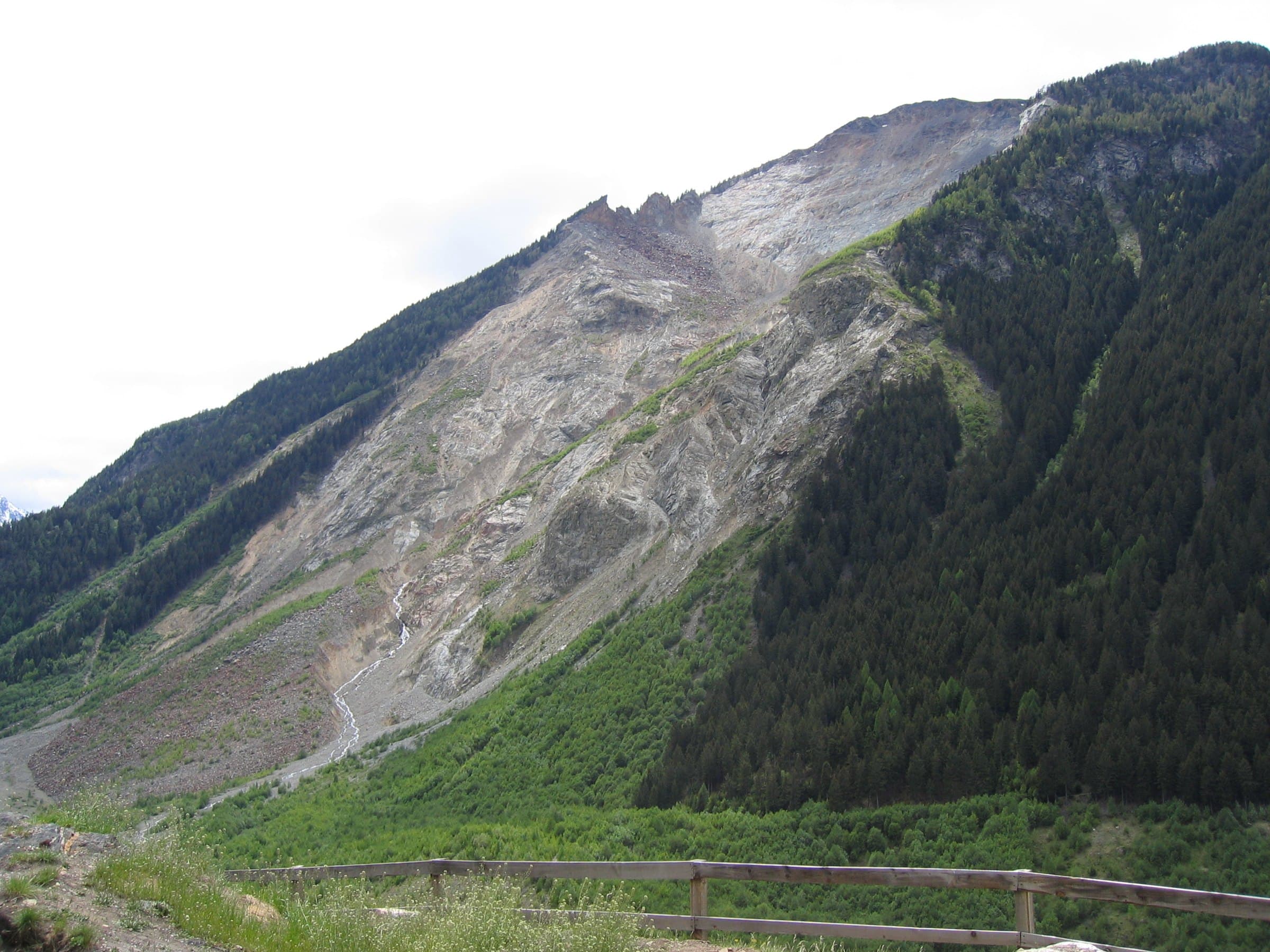
The Val Pola landslide (Monte Coppetto), 1987
The day the mountain fell: the Val Pola landslide, the lake that threatened the valley and the test of courage and solidarity of an entire community.
12 min read
There are dates that a community does not forget. For Valtellina one of them is 28 July 1987. It was a summer morning, shortly after seven. In the Val Pola, above the meadows and houses of Valdisotto, a soldier watching the slope from the opposite side shouted a phrase that became the symbol of that day: the trees were moving. A few moments later, an entire mountain was coming down into the valley. It is the story the Valtellinese call the landslide of Monte Coppetto: a name you will find written like this in conversations, in newspapers, even on plaques, although geologists remember it as the Val Pola landslide. This page tells it from close up, with respect, because behind the numbers lies the story of a territory that, after the fear, knew how to rise again.
One name, three mountains: Coppetto, Zandila and the Val Pola
First of all, a clarification that helps in understanding the maps and the accounts. The landslide broke away from Monte Zandila, on the slope facing the Val Pola, a small mountain corridor that climbs north-east from the valley floor of Valdisotto, south of Bormio. By a widespread habit among the people and in the newspapers it is known as the "landslide of Pizzo Coppetto", the name of the nearby peak, a mountain of 3,066 metres: an attribution, geologists say, that is improper, but has now entered common use. The two expressions therefore indicate the same event: the Val Pola landslide, the Monte Coppetto landslide, the Monte Zandila landslide. For those who lived it, it is simply "the landslide".
Valdisotto, the municipality that was struck, is formed by a narrow, luminous territory: the Adda valley which, right after the Bormio basin, descends towards Sondrio through a gorge, a bottleneck. Through that gorge pass the river, the Stelvio state road and the railway to the upper valley. That is why, when the mountain fell, it was not merely a local tragedy: it was like closing the front door of Alta Valtellina.
July 1987: a summer gone mad
To understand how it came to that morning, we must go back to mid-July. From arctic latitudes a great mass of cold air descended towards the Alpine arc, where a very warm and humid air mass was already present. Pressure fell sharply but temperatures stayed high: the freezing level was recorded at four thousand metres, at a height such that the rains reached even the highest glaciers. During June and July Valtellina saw exceptional rains and rapid melting of the glaciers.
The first blow came at Tartano, on 18 July, at 5:30 p.m.: an enormous mass of water and mud crashed onto the La Quiete apartment block, slicing it in half, involving the road below and the Gran Baita hotel. Twenty-one people lost their lives, eleven of them tourists. The same day the Adda broke its northern bank just west of San Pietro di Berbenno, flooding the village and involving Ardenno, Fusine, Selvetta and Cedrasco: roads and railways to the eastern part of the province were cut and many people were evacuated. At Sondrio the Mallero torrent was on the verge of overflowing, as was the Bitto at Morbegno; the Adda flooded the whole valley floor in the industrial area between Talamona and Morbegno; the village of Torre di Santa Maria was evacuated; links with Switzerland were cut, with the Piattamala customs post completely unusable. In Switzerland the Poschiavino and the Val da Li Acqui overflowed, involving the Val Poschiavo as far as Tirano. On Monday 20 July the Stelvio state road and the railway were still cut: Valtellina was isolated, though no longer subject to immediate danger.
The emergency, however, was not over: it was only moving, from lower to upper Valtellina.
The cracks in the mountain
The signal came from above. On the slope of the Val Pola, at the foot of Monte Zandila, someone noticed fissures. The discovery, according to reconstructions, took place on 25 July, a Saturday, almost by chance: during an inspection at 2,050 metres, at the locality of Boc, a geologist, Dr Traversi, and Adriano Greco found a fracture in the ground. A park ranger had reported fleeing from a landslide beneath Monte Zandila. Greco noticed that the ground in the fracture was dry, unlike the surrounding terrain, and said it was "a new Vajont". The fracture ran for over a kilometre, between 2,000 and 2,300 metres of altitude, and in places was some twenty metres wide. A helicopter brought three more mountain guides from Bormio. Dr Traversi judged the situation extremely urgent. The report was faxed to the prefect of Sondrio, and the pre-alarm went off. That night soldiers lit the slope with floodlights, and continuous monitoring, day and night, was necessary.
The next day, 26 July, the fracture widened and became visible to the naked eye. At 1,600-1,700 metres large blocks of rock appeared, probably the base of the slide, and falling stones reached the plain of Sant'Antonio Morignone. Observers saw the water of the torrents vanish into the ground and re-emerge further down. Geologists flew over the area and the evacuation of all the villages below was ordered. After the descent of mud and water in the preceding days, the idea that an entire mountain could fall seemed almost incredible. But the people who lived there, in those days, had the impression that something enormous was about to happen.
28 July 1987, 7:18 a.m.
At 7:18 on 28 July (some sources say 7:23) the slope gave way. A soldier watching from the opposite side shouted that the trees were moving. The men turned and ran uphill while the slope collapsed. A cloud of dust enveloped them, with rocks passing over their heads and a rush of air that took their breath away. When the cloud cleared, it was seen that the village of Morignone was no longer there.
Forty million cubic metres of material (estimates speak of a volume between 35 and 45 million) plunged down the valley, completely overwhelming and destroying the villages of Sant'Antonio Morignone and Aquilone, hamlets of Valdisotto. Fortunately the villages had been evacuated and this saved most of the population. Swept away by the landslide, however, were a team of seven workers who had come to the village to carry out repair work on the Stelvio state road, and some inhabitants of Aquilone who had remained in the hamlet because the area was mistakenly considered out of danger. No one had foreseen the displacement of water caused by the landslide: the wave climbed for several hundred metres up the opposite side of the mountain and cost many people their lives. The number of victims of the landslide is given, in the most cited reconstructions, as thirty-five; sources sometimes report different figures, and for the whole flood of the province of Sondrio, including the events at Tartano, the victims were fifty-three.
The slid material travelled about a kilometre and a half downstream and deepened the canyon of the Val Pola by some 35 metres. An enormous scar appeared in the landscape. In the middle of the debris, a small miracle: the church of San Bartolomeo de Castelàz, which thanks to its slightly raised position remained surrounded by the landslide but standing. After that morning, the prefect told the prime minister that Valtellina was now a catastrophe.
Why the mountain fell: the geologists' explanation
What happened, exactly, on that slope? Scholars have reconstructed it patiently. In the weeks of June and July 1987 Valtellina saw exceptional rains, accompanied by rapid glacier melting due to the very high freezing level. The swollen Val Pola torrent forcefully eroded the flanks of its valley, including an ancient accumulation zone of debris left by post-glacial landslides. A fracture thus formed, and from that point a volume of old debris estimated between 35 and 45 million cubic metres broke away from the northern slope of Monte Zandila, on the eastern side of Pizzo Coppetto.
The rock mass turned into a rapid rock avalanche, followed by secondary landslides on the flanks of the Val Pola and a debris flow along the valley floor, which carried with it millions of cubic metres of material. The cone that formed dammed the Adda and created a lake; the mass continued for about a kilometre and a half and generated, upstream, a wave of mud some thirty metres high that travelled for almost three kilometres. This is why, in the accounts, one speaks of a wave that climbed the opposite slope: a force that no one had foreseen. And precisely because it was not foreseen, some of the victims were swept away in areas that had been considered safe.
The sources, it must be said honestly, do not agree on all the figures: the death toll of the landslide alone is given variously as twenty-two, thirty-five or forty-two people, depending on whether only those swept away by the mass are counted or also those struck by the wave and by the effects of the emergency. What remains, and what no source disputes, is the scale of the event: an event of exceptional dimensions.
The lake on the Adda and the days of waiting
But the landslide was not the end. The debris formed a barrier some fifty metres high that blocked the normal flow of the Adda towards Tirano and southward. A natural lake thus formed, looming over the whole valley below. The water level rose on average by two centimetres an hour; there were sixty days to find a solution that would avoid overtopping or, worse, the collapse of the natural dam.
Throughout August the experts kept the lake under control, draining part of the water through bypass tunnels. But at the end of the month the rains resumed with force and the level rose by twenty centimetres an hour. Intervention on the body of the landslide became urgent, to create a new channel and allow controlled overtopping. It was one of the tensest moments: there were those who maintained it was the only solution and those who feared an even worse disaster if the front of the landslide gave way. In the end Minister Remo Gaspari authorised, under his own personal political responsibility, the controlled overtopping of the river's waters.
At 10 p.m. on Saturday 29 August the geologists Maione and Presbitero and the geotechnical engineer Pietro Lunardi took a drastic decision: to evacuate all the settlements along the course of the Adda, from Sondalo to Sondrio. We speak of some twenty-five thousand people who had to leave their homes, on a night of fear. The next day, Sunday 30 August, a breach was dug in the front of the landslide and the accumulated water began to be released, at a rate of forty cubic metres per second. The evacuees returned and in the following days the lake was completely emptied, while the Adda adapted to its new course. The Lombardy Region also decided to install a system of fourteen monitoring stations to keep the evolution of the situation constantly under control. After almost two months, the emergency ended.
Controversy and reconstruction
A tragedy of this scale could not fail to leave a mark. The disaster coincided with a change of government, and with the replacement of the Minister of Civil Protection, Zamberletti, who had long experience of national catastrophes, with Remo Gaspari, appointed on 28 July, in the midst of the Valtellina crisis: a changeover that, according to many, produced a certain decision-making vacuum and some less-than-ideal choices. The Goria government suspended taxes in Valtellina and exempted all young Valtellinese from military service. The final toll was very heavy: fifty-three dead, thousands displaced, damage estimated at about four thousand billion lire, equal to more than two billion euros today.
Parliament responded with a special law. On 2 May 1990 Law no. 102 was approved, the so-called Valtellina Law, which allocated 2,400 billion lire for the six-year period 1989-1994 for hydrogeological restructuring, monitoring, reconstruction and development of the municipalities of the province of Sondrio and of nearby areas of the provinces of Bergamo, Como and Brescia. A large monitoring system was installed in those years at several points in the valley (Campofrancia, Spriana, Torreggio, Val Pola), to monitor the evolution of landslide phenomena. In July 2007 a national civil protection exercise, "Valtellina 2007", simulated a risk similar to that of 1987.
Remembering: the Aquilone memorial
The villages of Sant'Antonio Morignone and Aquilone, where the landslide stopped, were not rebuilt where they were: beneath the debris, they rest forever. At Aquilone there now stands the memorial of the Val Pola landslide, a place of remembrance that in 2017, on the thirtieth anniversary, the President of the Republic Sergio Mattarella chose to visit. It is a simple and silent place, where one reads the names and looks at the mountain that has changed its shape. The church of San Bartolomeo de Castelàz, spared by the landslide, has become a symbol: a small church built after 1393, surrounded by an expanse of debris that over time has been covered by vegetation.
Today Valdisotto is a living community. There are the two ski areas of Oga, linked to San Colombano and Isolaccia, and of Bormio; there are the villages, the churches, the meadows. Walking in the valley, those who do not know it cannot imagine that beneath the pastures lies a fallen mountain. And this is perhaps the greatest sign of a territory's capacity for rebirth.
What 1987 left us
Looking back across the decades, the Val Pola landslide left us more than a memory. It left us a method: sensors and measuring stations have since monitored the movements of the slopes. It left us a culture: that of preventive evacuation, which that morning saved most of the inhabitants, and of prevention, for which it is not enough to wait for the emergency. It left us the memory of difficult decisions, taken at night, by people who took on enormous responsibilities. And it left us, above all, a lesson in humility: the mountain is beautiful, but it is never merely a backdrop. It changes, it moves, it lives.
Whoever visits Bormio and its valley today to ski, for the baths, for the mountains, can spend a few hours at this place. Not to seek a tragedy, but to understand. Here history is not a distant tale: it is a wound that has healed, and that reminds us how much a community that knows how to stay united is worth.
From Tirano: distance, driving time and day trip
The Val Pola and the Aquilone memorial are in Valdisotto, along the road that climbs from Tirano to Bormio: they can be visited on a short trip, perhaps before a day in Bormio, returning to Tirano in the evening.